Ask ten people how to raise a bilingual child and you will get ten confident, contradictory answers. One grandparent worries that two languages will confuse the baby. A neighbour insists it is pointless to start before school. Someone on a forum swears by strict rules about who speaks what. The research on childhood bilingualism goes back decades, and it is far more settled than the advice you will hear at the school gate. Most of the loud opinions turn out to be wrong in the same few ways.
Is there a best age to start a second language?
The idea of a critical period gets used to scare parents. The best recent evidence paints a calmer picture. In 2018, Hartshorne, Tenenbaum and Pinker analysed grammar-test data from about 670,000 English speakers and found that the ability to learn grammar stays high until roughly age 17, then tails off. The catch is that reaching native-like mastery takes years of learning, so children who start by around 10 to 12 have the best odds of getting all the way there. A 2022 reanalysis argued the decline may be gradual rather than a cliff, which is, if anything, more reassuring.
Sounds are the exception, and they favour starting very early. Werker and Tees showed back in 1984 that babies can hear the sound contrasts of any language at six to eight months, and mostly lose that ability for unused contrasts by their first birthday. This is why an accent is the one thing adults rarely shake. So the honest summary is: start whenever you can, the runway for grammar and vocabulary is long, but the earlier you start, the more effortless the sounds will be.
Can babies learn a language from screens?
The single most striking experiment in this field is Patricia Kuhl’s. Her team gave nine-month-old American babies twelve sessions of Mandarin. One group got a live human being, playing and reading with them. Other groups got the identical material on video or as audio. The babies with the live tutor learned to discriminate Mandarin sounds. The video and audio groups learned nothing at all . Not less. Nothing.
Follow-up work points the same way. Recordings of family life show that one-on-one “parentese”, that exaggerated sing-song way adults naturally talk to babies, predicts how much a child babbles and how many words they produce at age two. A 2018 brain-imaging study found that what predicts language development is not even the raw number of words a child hears but the number of back-and-forth conversational turns. Language grows out of interaction. A tablet playing French cartoons at a baby is, as far as the evidence goes, close to worthless. A parent reading one French picture book badly is worth a great deal.
How much exposure does a bilingual child need?
How much of each language a child hears is the strongest lever parents control. Pearson and colleagues measured bilingual infants and found that the share of their vocabulary in each language tracked the share of their waking hours spent hearing it, with a correlation of .82, which for child development research is enormous. Later work confirmed it and added a wrinkle: hearing a language from several different speakers, and from native speakers, helps independently of the sheer amount.
There is a sobering base rate hiding in this literature. In Annick De Houwer’s survey of nearly 1,900 bilingual families, about a quarter of children raised with two languages ended up understanding the minority language but not speaking it. The families that succeeded were not the ones with the cleverest rules. They were the ones where the minority language got the most air time, usually because both parents used it at home. The famous “one parent, one language” system turned out to be neither necessary nor sufficient. If you only take one strategy from this post, take that one: maximise the hours, not the rules.
And the old worry about confusion? Byers-Heinlein and Lew-Williams reviewed the evidence directly. Bilingual exposure does not confuse children and does not delay language. Mixing two languages in one sentence is a normal phase, not a warning sign.
What actually works at home?
If interaction and input are what count, the practical question is where an ordinary family finds twenty spare minutes of rich, one-on-one language every single day. The research community answered this one a long time ago: shared book reading.
Whitehurst’s 1988 trial trained parents to read interactively, asking open questions and expanding on the child’s answers, and produced measurably better expressive language within a month . A meta-analysis of these “dialogic reading” interventions found solid vocabulary gains, strongest for two and three year olds. Zoom out further and a review of 99 studies following children from infancy found that early print exposure feeds an upward spiral: reading builds vocabulary, which makes reading easier, which leads to more reading.
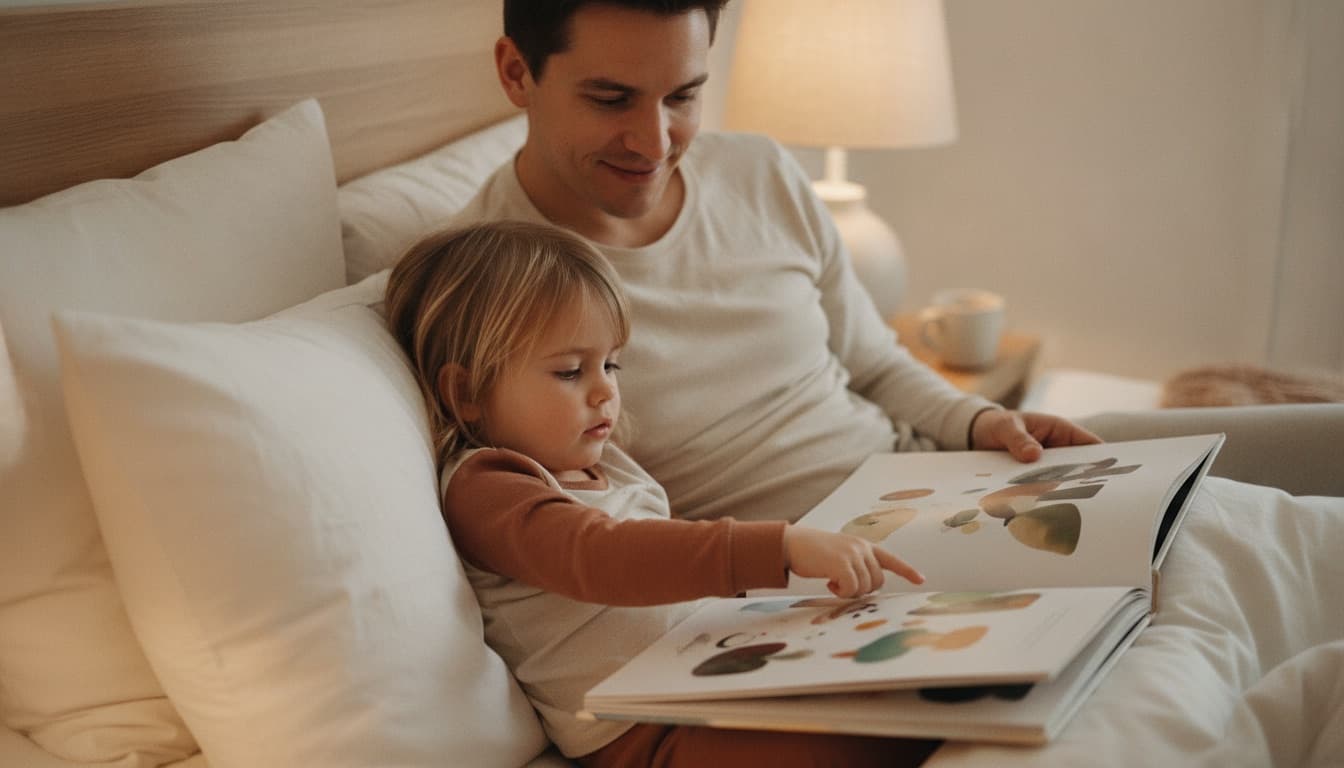
Bedtime is the natural place to put this, and not only for scheduling reasons. A consistent bedtime routine that includes reading is independently linked to better sleep and broader wellbeing benefits. A story in the minority language, every night, from a parent rather than a loudspeaker, checks every box the research cares about: interaction, repetition, rich vocabulary, and a child who associates the language with warmth rather than homework.
This research is why our Bilingual Bedtime editions put the French or German on one page and the English on the facing page, so a parent who only speaks English can still run the routine: read a paragraph in each language, point, compare, and let the child ask questions. The format matters less than the lap, but it helps to have a book built for the job.
Sources
- Hartshorne, Tenenbaum & Pinker (2018). A critical period for second language acquisition. Cognition, 177. pubmed.ncbi.nlm.nih.gov/29729947
- van der Slik et al. (2022). Critical period claim revisited. Language Learning. onlinelibrary.wiley.com/doi/10.1111/lang.12470
- Werker & Tees (1984). Cross-language speech perception. Infant Behavior and Development, 7. sciencedirect.com
- Kuhl, Tsao & Liu (2003). Foreign-language experience in infancy. PNAS, 100(15). pnas.org/doi/10.1073/pnas.1532872100
- Ramírez-Esparza, García-Sierra & Kuhl (2014). Look who’s talking. Developmental Science, 17(6). pmc.ncbi.nlm.nih.gov/articles/PMC4188803
- Romeo et al. (2018). Beyond the 30-million-word gap. Psychological Science, 29(5). pmc.ncbi.nlm.nih.gov/articles/PMC5945324
- Pearson et al. (1997). The relation of input factors to lexical learning by bilingual infants. Applied Psycholinguistics, 18. cambridge.org
- Place & Hoff (2011). Properties of dual language exposure. Child Development, 82(6). pmc.ncbi.nlm.nih.gov/articles/PMC4144198
- De Houwer (2007). Parental language input patterns and children’s bilingual use. Applied Psycholinguistics, 28. cambridge.org
- Byers-Heinlein & Lew-Williams (2013). Bilingualism in the early years: what the science says. LEARNing Landscapes, 7(1). pmc.ncbi.nlm.nih.gov/articles/PMC6168212
- Whitehurst et al. (1988). Accelerating language development through picture book reading. Developmental Psychology, 24(4). psycnet.apa.org/record/1989-02401-001
- Mol, Bus, de Jong & Smeets (2008). Added value of dialogic parent-child book readings: a meta-analysis. Early Education and Development, 19(1). tandfonline.com
- Mol & Bus (2011). To read or not to read: a meta-analysis of print exposure from infancy to early adulthood. Psychological Bulletin, 137(2). PDF
- Mindell & Williamson (2018). Benefits of a bedtime routine in young children. Sleep Medicine Reviews, 40. pubmed.ncbi.nlm.nih.gov/29195725