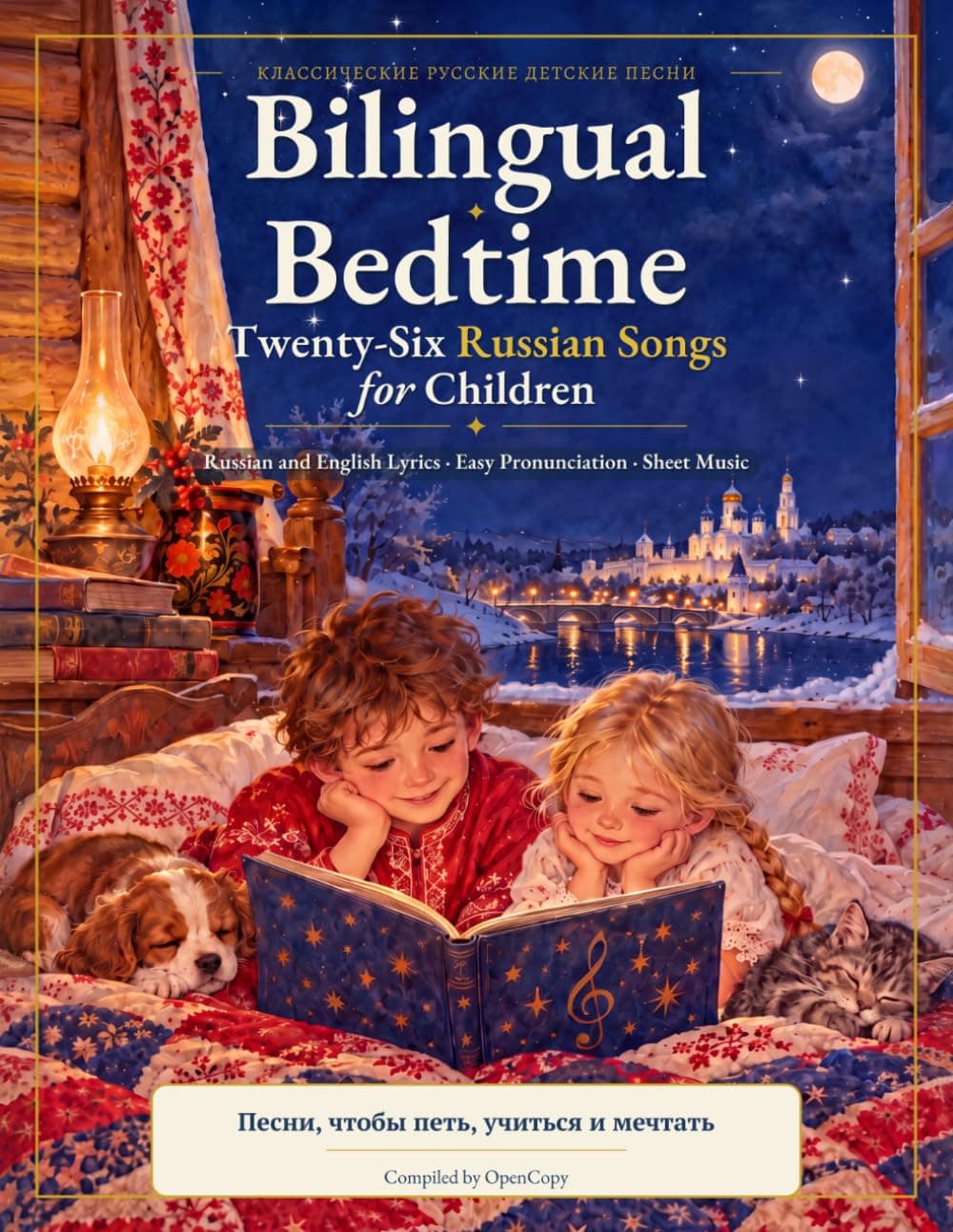
Bilingual Bedtime.
Traditional · Twenty-Six Russian Songs for Children
Twenty-six classic Russian children's songs, from play rhymes for the lap to lullabies, each on a painted spread with its melody on a staff, a grey line under every Russian line that spells out how to say it, and plain English under that, so a parent who cannot read the Russian alphabet can sing them tonight.
80 pages · Paperback & Kindle · Ages 2 to 6
the opening of “Ладушки”, as printed: Russian, then how to say it, then the English
Twenty-six songs, in order.
From playtime to bedtime: play rhymes for the lap first, then calls to the rain and the sun, the ring dances, two story songs, the festive songs of Christmastide and Butter Week, and five lullabies to close the day.
Every song opens on a spread of its own. On the left is a full-page painting; on the right the tune sits on a staff at the top of the page, with the first verse set under the notes, and the words run below it in two clear columns. The Russian is in large type. Under each Russian line sits a small grey line that tells you how to say it, and under that a plain English line that tells you what it means. Most songs fit that one page whole; the longer ones carry on over the pages that follow, among them the twenty verses of Во поле берёза стояла and the twenty-three of Как у наших у ворот.
The grey line is written for parents who do not read Russian, and you do not need to know the alphabet to use it. It spells each word the way an English reader would say it, syllable by syllable, so Ладушки, ладушки becomes lah-doosh-kee, lah-doosh-kee. It follows the tune, so it spells the words as they are sung: an o without the stress is sung as an open ah, and the one-letter words в, к and с are joined to the word that follows. Stress is not marked, in the Russian or in the grey line: the tune usually puts the stressed syllable on a strong beat, though not always. The English beneath is literal: what the line means, not a singable rewrite.
The words of every song come from a named print of before 1926, most of them from the Moscow school songbook of 1904 and Lvov and Prach's collection of 1806, the rest from Shein's great folk collection, Rimsky-Korsakov's of 1877, Dahl's dictionary and a few others, set in modern spelling. Where an old or country word form is part of the song, it is kept and the note explains it. Each song carries a note of its own: where it comes from, what the game or gesture is if there is one, and, where the book leaves out part of the old print, which part. Three guide pages for grown-ups open the book: singing together, the sounds of Russian, and reading the music.
- 01ЛадушкиPlay rhyme: Little palms, little palms
- 02Сорока-воронаPlay rhyme: Magpie, crow
- 03Скок-поскокPlay rhyme: Hop, skip, young little thrush
- 04Петушок, петушокPlay rhyme: Little rooster, little rooster, golden comb
- 05Ходит зайка по садуPlay rhyme: The little hare walks through the garden
- 06Тень-тень-потетеньPlay rhyme: Shadow, shadow, poteten
- 07Дождик, дождикCalling song: Little rain, little rain, stop
- 08Солнышко-вёдрышкоCalling song: Little sun, fair-weather sun
- 09Заинька, попляшиCircle dance: Little hare, hop about
- 10А мы просо сеялиCircle dance: And we have sown the millet
- 11Во поле берёза стоялаCircle dance: In the field a birch tree stood
- 12Со вьюном я хожуCircle dance: I walk with the bindweed
…and fourteen more, among them Как у наших у ворот, Чижик-пыжик, Кошкин дом, the Christmastide carols Ой, Авсень! and Таусень, the Butter Week song А мы Масленицу дожидаем, and the lullabies Идёт коза рогатая, Баю-баюшки-баю and Lermontov's Казачья колыбельная.
Why this edition.
The tune on every page
Each song's melody is engraved on a staff at the top of its page, with the first verse set under the notes. A short guide at the front explains how to read the staff, for anyone who never learned, and what the (bis) after a line means. Four tunes are by named composers, three by Lyadov and one by Kalinnikov, and the note with each says so.
A line that tells you how to say it
Under every Russian line, a small grey line spells the words the way an English reader would say them, syllable by syllable, in lower case. You do not need the Russian alphabet to use it. It follows the tune, so it spells the words as they are sung. Sing from the Russian as soon as you can; the grey line is a crutch to throw away.
Plain English under every line
The English says exactly what each Russian line means, not a singable rewrite, so you always know what you are singing to your child. Where a word needs more than a line can give, the note explains it: Ладушки comes from ладони, palms, and a плетень is a fence woven from willow rods.
The words the old books printed
The words of every song follow a named print of before 1926, chiefly the Moscow school songbook of 1904 and Lvov and Prach's collection of 1806, in modern spelling. Where the old words differ from the version families sing today, the note says so: the siskin of Чижик-пыжик drinks на канавке, by the canal, and the note gives на Фонтанке, as it is sung today.
A painting for every song
Twenty-six original full-page watercolours, one on the left of every spread: a grandmother pouring tea from the samovar while a toddler claps, children dancing in a ring under a birch, carol singers carrying a paper star through the snow. A note with each song says where it comes from and, for the play rhymes, what the hands do, from the clapping of Ладушки to the finger play of Сорока-ворона.
the first verse of Lermontov's “Казачья колыбельная”, the Cossack Lullaby, as printed: Russian, how to say it, English
The details.
- Series
- Bilingual Bedtime
- Language pair
- Russian lyrics with a pronunciation line and English under every line
- Format
- Paperback & Kindle
- Print length
- 80 pages
- Trim size
- 8.5 × 11 in
- Source text
- Prints of before 1926, chiefly the Moscow school songbook of 1904 and Lvov and Prach (1806), in modern spelling
- Melodies
- An engraved staff for every song, the first verse under the notes
- Illustrations
- 26 original full-page watercolours, one per song
- Kindle edition
- Reflowable: one song per page with its staff and all three lines; the paintings are in the paperback only
- Level
- Ages 2 to 6
- Published
- September 2026
- ASIN
- B0HL8KCVT2
More in Russian.
Every edition is glossed by hand, word by word, and printed on demand by Amazon.
Sing the old songs of the Russian nursery, one at bedtime, the same song for a week.
Buy paperback