opencopyInterlinear Books
Look insideHow it worksBlogContact
  • Look inside
  • How it works
  • Blog
  • Contact
Bilingual Bedtime/German songs
KanonRound

Es tönen die Lieder.

Es tönen die Lieder, der Frühling kehrt wieder
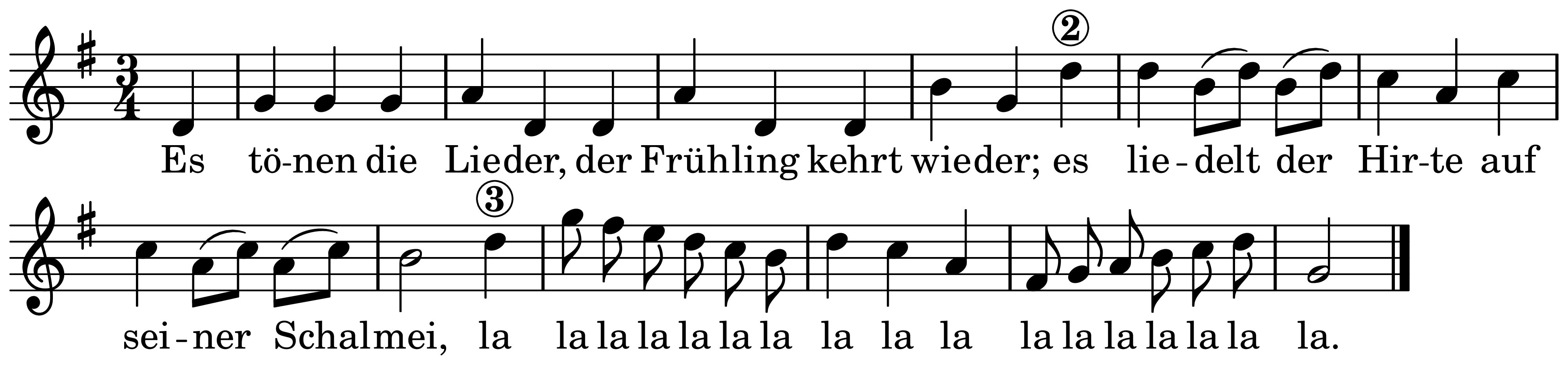
The melody of Es tönen die Lieder on a staff, as engraved in the book
Download the tune

The melody as written on the staff, so you can learn the tune before you sing.

  1. Es tönen die Lieder, der Frühling kehrt wieder;ehs ter-nuhn dee lee-der, dair frew-ling kayrt vee-der;The songs ring out, the spring comes back again;
  2. es liedelt der Hirte auf seiner Schalmei,ehs lee-duhlt dair hir-tuh owf zai-ner shahl-mai,the shepherd makes his little song on his reed pipe,
  3. la la la la la la la la la lalah lah lah lah lah lah lah lah lah lahla la la la la la la la la la
  4. la la la la la la la.lah lah lah lah lah lah lah.la la la la la la la.
About this song

A three voice canon, first printed in 1869 from the papers of the gymnastics teacher Adolf Spieß, who had children step it in threes at a school festival. Voice two starts when voice one reaches the circled 2, voice three at the circled 3. A Schalmei is a shepherd's reed pipe, and liedelt means sings a little song.

Where it comes from

The words: Reigen und Liederreigen für das Schulturnen, aus dem Nachlasse von Adolf Spieß, herausgegeben von Dr. Wassmannsdorff (J. D. Sauerländer's Verlag, Frankfurt a. M., 1869), S. 79.

The tune: The first print engraves the tune over the words, so the reference is the source's own staff: Reigen und Liederreigen für das Schulturnen, aus dem Nachlasse von Adolf Spieß (Sauerländer, Frankfurt a. M., 1869), S. 79, headed „Dreistimmiger Wechselsang; ‚Es tönen die Lieder, der Frühling kehrt wieder‘, mit dreischrittigem Wechselgang.“ and „3/4 Tact.“, three systems of four bars, treble clef, one sharp (G major), a one-quarter upbeat (archive.org bub_gb_xKdAAAAAcAAJ, page image n92_w2000.jpg). Every pitch is read off that engraving: the five staff-line rows of each system found by pixel row density, then each notehead's centre by the rows whose dark run is a notehead wide rather than a stem wide, and measured against those lines. Spieß's G major lies inside the book's C-to-G range, so his key is kept; range d' to g''. His own three systems of four bars come out 2.20 in tall, a hair over the staff cap, so the same twelve bars are set here as two systems of six. The print marks the two canon entries with an asterisk over the last note of its first and second systems (the "es" of "es liedelt" and the first "la"); those two notes carry the circled 2 and 3 here. Cross-checked degree for degree against the score block in the "Text und Melodie" section of the de.wikipedia article "Es tönen die Lieder" (F major, 3/4, a whole tone lower): the rhythm agrees bar for bar and 39 of the 44 pitches agree. The two partings print Spieß's plate: bar 3 ("Früh-ling kehrt") repeats bar 2 as a' d' d' where Wikipedia has three a's, and the last note of bar 11 rises to d'' here, closing an ascending scale, where Wikipedia falls back to a'. Both readings still sound the dominant seventh on D against the other two voices. 44 notes carry the 40 syllables of the single verse; the four slurred quaver pairs in bars 5 and 7 are the plate's own slurs and take one syllable each

From the book

Bilingual Bedtime

Thirty-Seven German Songs for Children

Buy paperbackBuy KindleBuy hardcoverAbout this edition
Hänsel und Gretel verliefen sich im WaldAll 37 songsFroh zu sein bedarf es wenig
opencopy© 2026
Look insideHow it worksBlogAboutJobsContactPrivacyTermsAccessibility