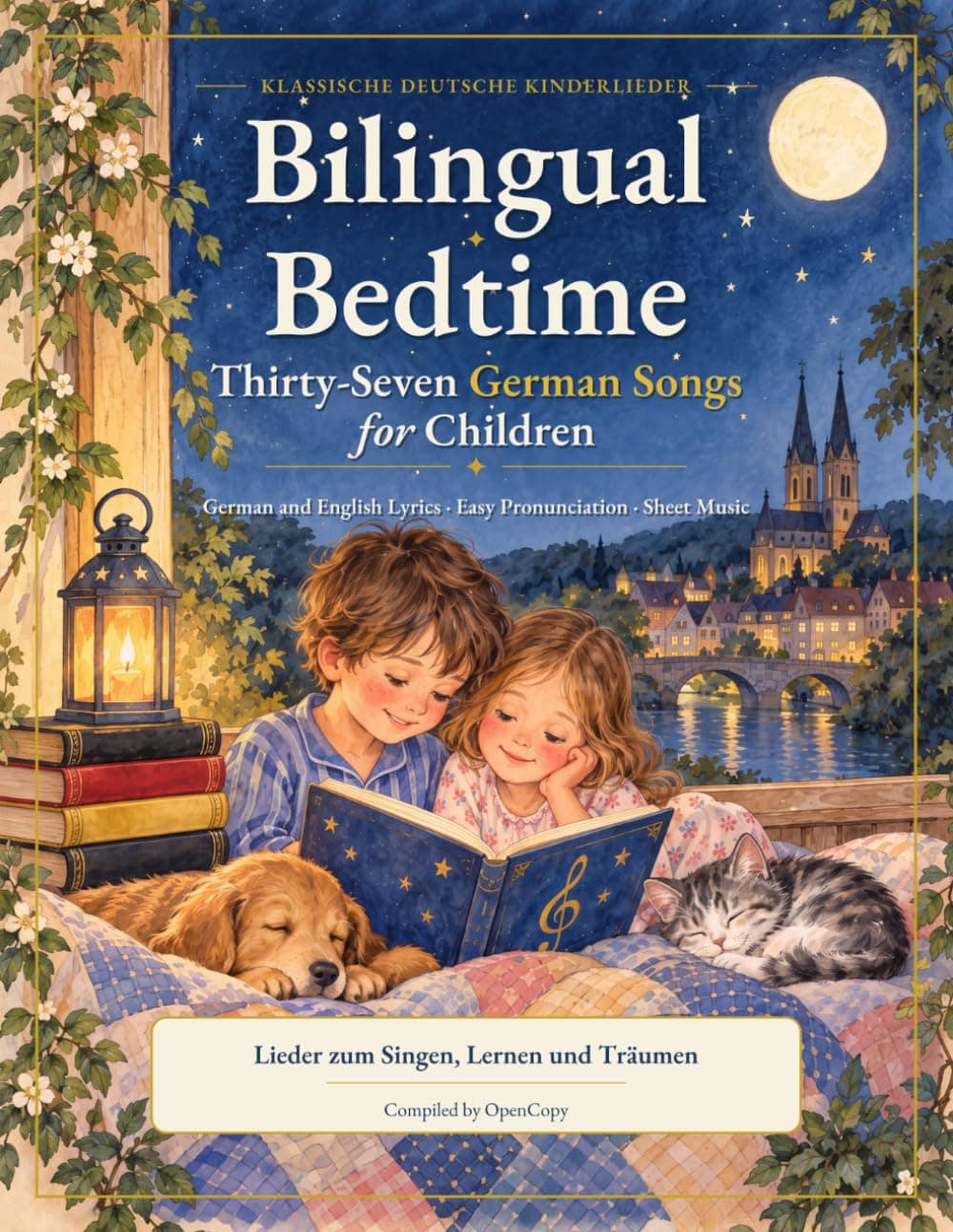
Bilingual Bedtime.
Traditional · Thirty-Seven German Songs for Children
Thirty-seven classic German children's songs, from knee-riding rhymes to lullabies, each with its melody on a staff, a grey line under every lyric that spells out how to say it, and plain English under that, so a parent with no German at all can sing them tonight.
110 pages · Paperback, Kindle & hardcover · Ages 2 to 6
the opening of “Alle meine Entchen”, as printed: German, then how to say it, then the English
Thirty-seven songs, in order.
From playtime to bedtime: knee-riding and hand-clapping rhymes first, then action songs, ring dances, story songs, two rounds, the songs of Martinmas and Christmas, and six lullabies to close the day.
Every song opens on a spread of its own. On the left is a full-page painting; on the right the tune sits on a staff at the top of the page, with the first verse set under the notes, and the words run below it in two clear columns. The German is in large type. Under each German line sits a small grey line that tells you how to say it, and under that a plain English line that tells you what it means. Most songs fit that one page whole; the longer ones carry on over the pages that follow, because every verse is printed in full, all seven of Der Mond ist aufgegangen and all six of Schlaf, Kindlein, schlaf.
The grey line is written for parents who do not read German. It spells each word the way an English reader would say it, syllable by syllable, so Backe, backe Kuchen becomes bah-kuh, bah-kuh koo-khuhn. It follows the tune rather than the dictionary, so every final e that is sung gets its own syllable, and it is set in lower case throughout, German nouns included, so nothing on that line looks like a word you are meant to know. The English beneath it is literal: what the line means, not a singable rewrite. A short note with each song says where it comes from, what it is for, and the gesture that goes with it if there is one.
The words are the ones the old printed collections give, Böhme's Deutsches Kinderlied und Kinderspiel of 1897, Des Knaben Wunderhorn of 1808 and Hoffmann von Fallersleben's Kinderlieder among them, with the spelling lightly modernised. Where a print keeps a word no longer used, or gives a tune in an older form than the one families sing today, the staff is captioned Historical version and the note names the familiar form. Thirty-seven watercolours were painted for this edition, one for every song.
- 01Backe, backe KuchenAction song
- 02Hoppe, hoppe, ReiterAction song
- 03Häschen in der GrubeAction song
- 04Hopp, hopp, hoppAction song
- 05Spannenlanger HanselAction song
- 06Brüderchen, komm tanz mit mirAction song
- 07Ringel, Ringel, ReiheCircle dance
- 08Es tanzt ein Bi-Ba-ButzemannCircle dance
- 09Alle meine EntchenStory song
- 10Fuchs, du hast die Gans gestohlenStory song
- 11Alle Vögel sind schon daStory song
- 12Ein Männlein steht im WaldeStory song
…and twenty-five more, among them Summ, summ, summ, Hänschen klein, Ich geh mit meiner Laterne, O Tannenbaum, Weißt du, wie viel Sternlein stehen, Der Mond ist aufgegangen, Guten Abend, gut' Nacht and Schlaf, Kindlein, schlaf.
Why this edition.
The tune on every page
Each song's melody is engraved on a staff with the first verse set under the notes, and the two rounds have their entries marked. A short guide at the front explains how to read the staff, for anyone who never learned.
A line that tells you how to say it
Under every German line, a small grey line spells the words the way an English reader would say them, syllable by syllable, in lower case so it never looks like German. It follows the tune, so every sung syllable is there. Sing from the German as soon as you can; the grey line is a crutch to throw away.
Plain English under every line
The English says exactly what each German line means, not a singable rewrite, so you always know what you are singing to your child. Every verse is printed in full, not trailed off after the first.
The words the grandparents sang
Every song is transcribed from an old printed collection, with the spelling lightly modernised. Where a print keeps an older word or an older tune than the one families sing today, the staff is captioned Historical version and the note tells you the form you may already know.
Painted for this edition
Thirty-seven original watercolours, one for every song, each filling the left-hand page of the song's spread. A note with each song says where it comes from, what it is for, and the gesture that goes with it, from knee-riding to hand-clapping.
the first verse of “Schlaf, Kindlein, schlaf”, the words as Des Knaben Wunderhorn printed them in 1808: German, how to say it, English
The details.
- Series
- Bilingual Bedtime
- Language pair
- German lyrics with English under every line
- Format
- Paperback, Kindle & hardcover
- Print length
- 110 pages
- Trim size
- 8.5 × 11 in (paperback), 8.25 × 11 in (hardcover)
- Source text
- Old printed collections, most of them nineteenth-century, Böhme's Deutsches Kinderlied und Kinderspiel (1897) among them, spelling lightly modernised
- Melodies
- An engraved staff for every song, the first verse under the notes
- Illustrations
- 37 original watercolours, one per song
- Kindle edition
- Reflowable: one song per page with its staff and all three lines; the paintings are in the print editions only
- Level
- Ages 2 to 6
- Published
- September 2026
- ASIN
- B0HKHRD1Z4
More in German.
Every edition is glossed by hand, word by word, and printed on demand by Amazon.
Sing the songs every German child grows up with, one at bedtime, the same song for a week.
Buy paperback