opencopyInterlinear Books
Look insideHow it worksBlogContact
  • Look inside
  • How it works
  • Blog
  • Contact
Bilingual Bedtime/German songs
FestliedFestive song

Ich geh mit meiner Laterne.
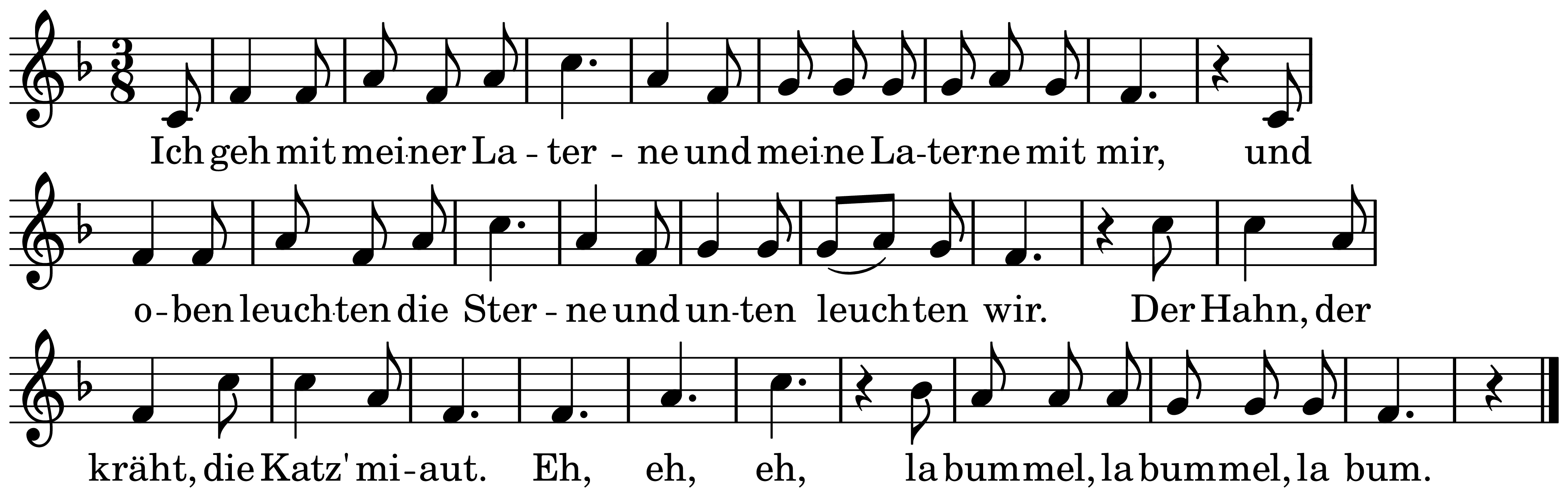
The melody of Ich geh mit meiner Laterne on a staff, as engraved in the book
Historische Fassung · Historical version
Download the tune

The melody as written on the staff, so you can learn the tune before you sing.

  1. Ich geh mit meiner Laterneikh gay mit mai-ner lah-tehr-nuhI go with my lantern
  2. und meine Laterne mit mir,oont mai-nuh lah-tehr-nuh mit meer,and my lantern with me,
  3. und oben leuchten die Sterneoont oh-buhn loykh-tuhn dee shtehr-nuhand up above the stars are shining
  4. und unten leuchten wir.oont oon-tuhn loykh-tuhn veer.and down below we are shining.
  5. Der Hahn, der kräht, die Katz' miaut.dair hahn, dair kreht, dee kahts mi-owt.The cockerel crows, the cat meows.
  6. Eh, eh, eh,ay, ay, ay,Eh, eh, eh,
  7. la bummel, la bummel, la bum.lah boom-muhl, lah boom-muhl, lah boom.la bummel, la bummel, la bum.
About this song

A lantern song for dark autumn evenings, sung on the walk itself, with paper lanterns on sticks. Fritz Jöde printed this version in 1913, and its second half is not the one sung today in words or in tune: where he has the cockerel and la bummel, children now sing Mein Licht ist aus and rabimmel, rabammel, rabum.

Where it comes from

The words: Fritz Jöde, Ringel Rangel Rosen. 150 Singespiele und 100 Abzählreime, nach mündlicher Überlieferung gesammelt (B. G. Teubner, Leipzig und Berlin, 1913), IX. Laternenlieder, Nr. 150 "Ich gehe mit meiner Laterne", S. 134.

The tune: The engraving printed with this very text: Fritz Jöde, Ringel Rangel Rosen (B. G. Teubner, Leipzig und Berlin, 1913), IX. Laternenlieder, Nr. 150 "Ich gehe mit meiner Laterne", S. 134. A single unaccompanied melody line, one flat in the signature (F major), 3/8, an eighth of anacrusis, four systems of seven bars, no tempo word, no dynamic and no composer line; the last bar holds a quarter rest alone before the final double barline, which with the anacrusis makes up one 3/8 bar so the children can start the next lantern song at once. The staff line rows of all four systems were measured off the page image and every notehead read against them, and the readings that decide a divergence from the modern form were re-cropped at 900 percent and checked stem and flag. Cross-checked degree for degree against the score block in the Melodie section of the de.wikipedia article "Ich geh’ mit meiner Laterne" (G major, 3/8): the two agree through the whole first half, and differ in three places, all of them Jöde's own. Jöde drops the modern "da" of "und unten, da leuchten wir" and beams and slurs its note into a two-note melisma on "leuch-"; his pickup into each half of "Der Hahn, der kräht, die Katz' miaut" is c'' where Wikipedia's "Mein Licht ist aus" has a'; and his tail "Eh, eh, eh, la bummel, la bummel, la bum" is a plain descent from bes' that Wikipedia's "rabimmel, rabammel, rabum" does not have. The print's own F major is kept; range c' to c''

From the book

Bilingual Bedtime

Thirty-Seven German Songs for Children

Buy paperbackBuy KindleBuy hardcoverAbout this edition
Froh zu sein bedarf es wenigAll 37 songsMorgen kommt der Weihnachtsmann
opencopy© 2026
Look insideHow it worksBlogAboutJobsContactPrivacyTermsAccessibility