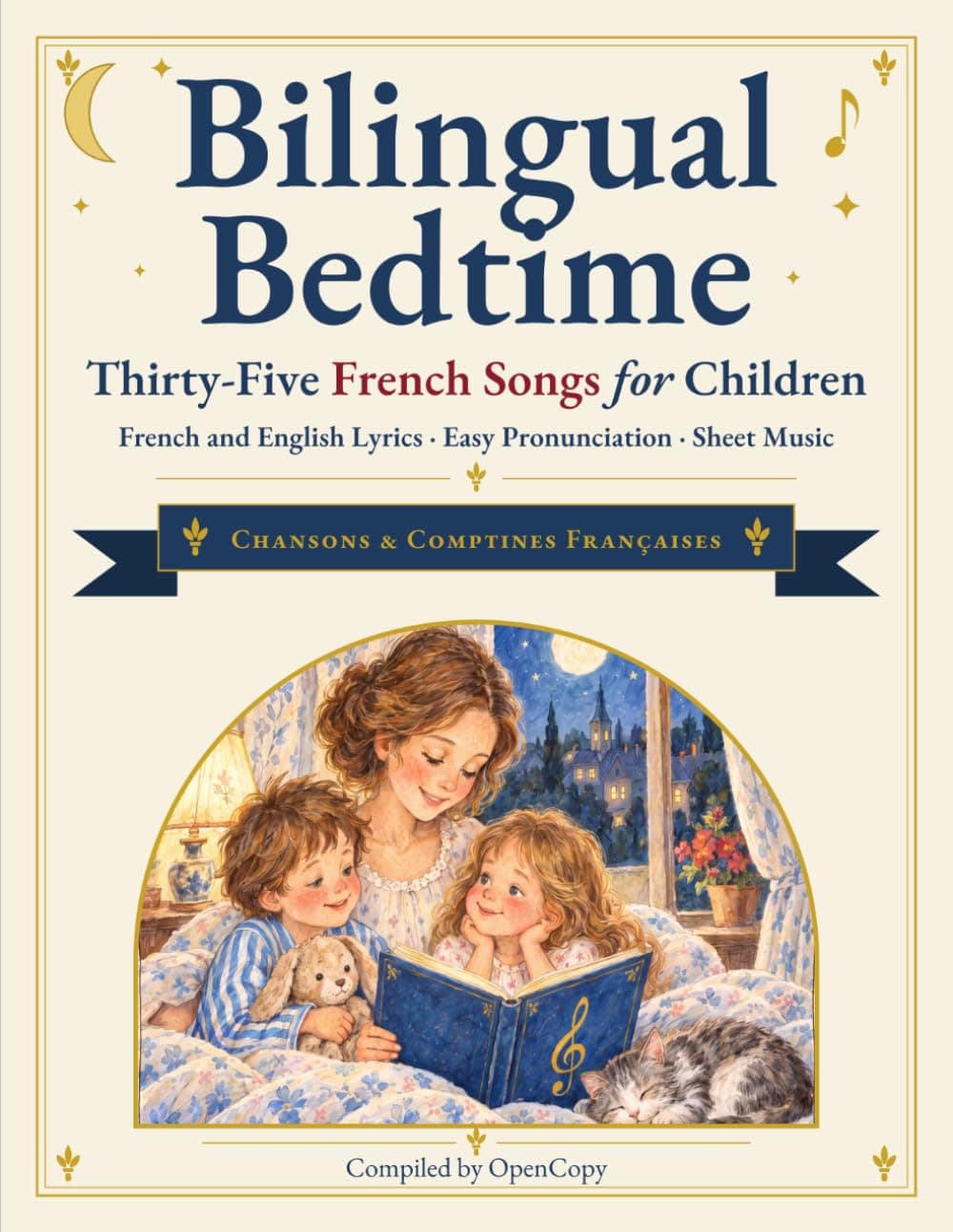
Bilingual Bedtime.
Traditional · Thirty-Five French Songs for Children
Thirty-five traditional French songs for children, each on a painted spread of its own: the French words in large type, a small grey line under each that spells out how to say it, the English meaning beneath that, and the tune on a staff, so a family can sing together with no French at all.
112 pages · Paperback, Kindle & hardcover · Ages 3 to 10
the opening of “Frère Jacques”, as printed: French, then how to say it, then the English
Thirty-five songs, in order.
Counting rhymes and action songs first, then the circle dances, the long story songs and the walking songs, and four lullabies to close the day.
Every song opens on a spread of its own. On the left is a full-page watercolour painted for that song. On the right sit the tune on a staff and the words in two clear columns: the French in large type, under it a small grey line that tells you how to say it, and under that a plain English line that says exactly what the French means. Most songs fit that one page whole. The long story songs carry straight on over the pages that follow, because every verse is printed in full, all twenty-two of Malbrough, all of Cadet Rousselle, the whole of Le bon roi Dagobert.
The grey line is written for parents who do not read French. It spells each word the way an English reader would say it, syllable by syllable, with the linking sounds shown where they happen, and it follows the tune rather than the dictionary, so a sung final e gets its own syllable. Sing from the French as soon as you can; the grey line is a crutch to throw away. The English under it is a literal meaning, not a singable rewrite, so you always know what you are singing to your child.
The words are the traditional ones, taken from the old printed collections, chiefly Weckerlin's Chansons et rondes enfantines of 1870, and lightly modernised in spelling, so what you sing is what French grandparents sang. Where children today sing a verse the old print lacks, it is printed too and marked as a later addition; where the old print keeps a word no longer used, a short note says so. Each song carries a note of its own, where it comes from, what it is for, and the gesture if there is one, and three guide pages for grown-ups open the book: singing together, the sounds of French, and how to read the staff.
- 01Frère JacquesRound: Brother James, Brother James
- 02Une souris verteCounting rhyme: A green mouse
- 03Une poule sur un murCounting rhyme: A hen on a wall
- 04Pomme de reinette et pomme d'apiCounting rhyme: I am a fruit seller
- 05Un, deux, trois, nous irons au boisCounting rhyme: One, two, three
- 06Ainsi font, font, fontAction song: Thus they do, do, do
- 07Savez-vous planter les chouxAction song: Do you know how to plant cabbages
- 08Tourne, tourne, mon moulinAction song: Turn, turn, my mill
- 09Les petits poissons dans l'eauAction song: The little fish in the water
- 10Notre âneAction song: Our donkey, our donkey
- 11Meunier, tu dorsAction song: Miller, you are sleeping
- 12Jean Petit qui danseAction song: Jean-Petit dances
…and twenty-three more, among them Alouette, Sur le pont d'Avignon, Promenons-nous dans les bois, Il pleut, il pleut, bergère, À la claire fontaine, Cadet Rousselle, Le bon roi Dagobert, Malbrough s'en va-t-en guerre and Il était un petit navire, ending with the lullabies Fais dodo, Colas, mon p'tit frère, Dodo, l'enfant do, Au clair de la lune and Ah ! vous dirai-je, maman.
Why this edition.
Three rows under every line
The French in large type, a grey line that spells out how to say it, and the plain English meaning. Read down the three rows and you have the sound and the sense of the line at once. No accent required: sing the grey line until the French comes on its own.
The tune on every page
Each melody is engraved on a staff with the first verse set under the notes, and the rounds have their entries marked. A short guide at the front shows a parent who has never read music how to follow it, and the second voice of Frère Jacques knows where to come in.
Every verse, as the old prints give it
The words come from the old printed collections, lightly modernised in spelling, and nothing is trailed off after the first verse. Where families today sing a verse the old print lacks, it is printed too and marked as a later addition. Where an old word survives because it carries the rhyme or the tune, the note explains it.
A painting for every song
Thirty-five original full-page watercolours, one on the left of every spread: a sleepy monk in his bell tower, Pierrot at his window, a lark over a wheat field. The picture gives the child something to look at while the song is learnt.
Playful by day, gentle by night
Counting rhymes to point with, action songs with their gestures, circle dances, rounds, the long story songs, and four lullabies placed at the end so the book closes as the day does. One song at bedtime, the same song for a week, and the words settle on their own.
the first verse of “Au clair de la lune”, as printed: French, then how to say it, then the English
The details.
- Series
- Bilingual Bedtime
- Language pair
- French and English, line by line, with a pronunciation line
- Format
- Paperback, Kindle & hardcover
- Print length
- 112 pages
- Trim size
- 8.5 × 11 in (paperback), 8.25 × 11 in (hardcover)
- Source text
- Traditional lyrics from old printed collections, chiefly Weckerlin (1870), lightly modernised in spelling
- Music
- An engraved melody staff for every song
- Illustrations
- 35 original watercolours, one for every song
- Kindle edition
- Reflowable: every song with its staff, the French, the pronunciation line and the English; the paintings are print only
- Level
- Ages 3 to 10
- Published
- September 2026
- ASIN
- B0HKCN2RY8
More in French.
Every edition is glossed by hand, word by word, and printed on demand by Amazon.

Sing the songs every French child grows up singing, with the words, the sounds and the meaning on one page.
Buy paperback