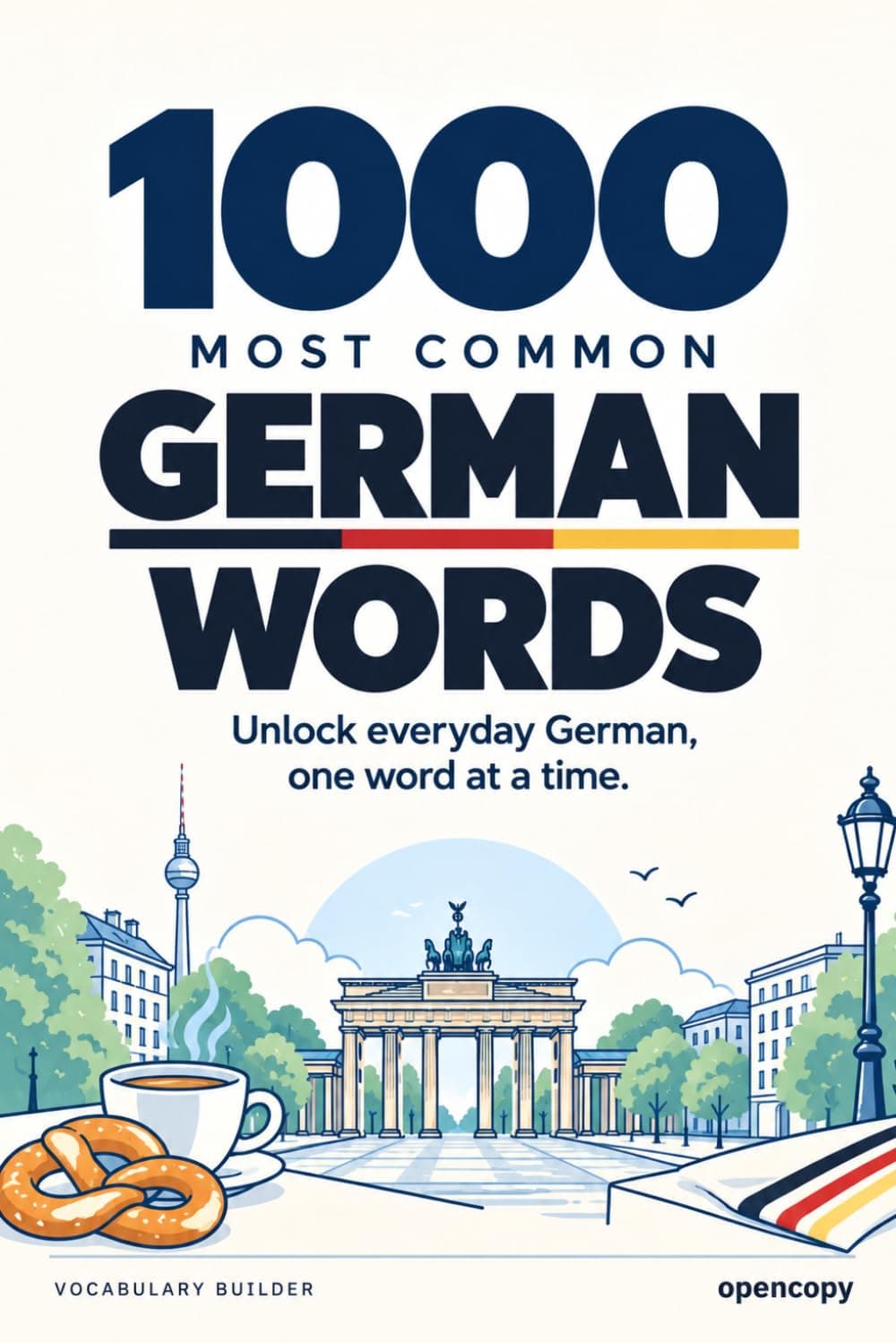
1000 Most Common German Words.
Vocabulary Builder
The 1,000 words that make up about 70% of everyday written German, starting with the ones English has already taught you, each with IPA, an easy English respelling and three example sentences glossed word by word.
260 pages · Paperback & Kindle · Beginner
an example sentence from the entry for Wasser (water)
Patterns, not lists.
One thousand high-frequency words in two Parts and 34 chapters of words: the ones you already know, then the rest by everyday theme.
English and German are cousins, so you already know more German than you think. Hand, Name and Hotel look almost exactly like their English twins, and regular sound shifts link many more: where English has th, German often has d (denken is think), an English t often becomes z or ss (zwei is two, Wasser is water), and k often becomes ch (machen is make). A core of just 1,000 words makes up about 70% of everyday written German, and this book starts with the ones you can almost read on sight.
Part 1, Words You Already Know, gathers 516 of the thousand: two chapters of near-twins, six built on the sound shifts, and eight of close cousins such as haben (have), Haus (house) and Freund (friend). Part 2 sorts the rest by everyday theme, from the small words that hold sentences together (aber, wenn, dass) to people, home, time, places, feelings, actions, describing words, talking and ideas, so related words stay together.
Every entry gives the meaning, the IPA and an easy English respelling with the stressed syllable in capitals, and every noun shows der, die or das and its plural, if it has one: Hand (die; pl. Hände). Three example sentences follow, glossed word by word with a natural translation underneath, so the grammar arrives with the vocabulary. Four guides come first: how to pronounce German, the words most likely to fool you (Kind is a child, fast means almost), the everyday phrases German builds differently, from ich habe Hunger (I'm hungry) to es gibt (there is), and four pages of the grammar you need. The most common irregular verbs carry a conjugation table, each Part ends with a test, and the answer key and an A–Z dictionary of all 1,000 words sit at the back.
- 01Almost the sameWords spelled almost exactly as in English: Hand, Name, Hotel, Sport, Moment
- 02Sound-shift tricksSix chapters on the shifts that link the two languages: th to d (denken, think), d to t (gut, good), t to z or ss (Wasser, water), p to f (helfen, help), k to ch (machen, make)
- 03Cousins you already knowClose enough to guess aloud: haben is have, Haus is house, Freund is friend
- 04Three sentences per entryWord-by-word English glosses and a natural translation; nouns show der, die or das and their plural
- 05Four guides up frontHow to Pronounce German, Words That Fool You, Say It the German Way, and The Grammar You Need: word order, the four cases, split verbs, the perfect and the modal verbs
- 06Verb tables, tests and a dictionaryTables for 65 irregular verbs, a Test Yourself at the end of each Part with the answers at the back, and all 1,000 words from A to Z
Chapter introductions add short pattern notes along the way: German -isch often matches English -ic or -ical (politisch is political), au often matches ou or ow (Haus and house, Maus and mouse), and nouns in -ung are always die.
Why this edition.
Start from what you know
Part 1, Words You Already Know, holds 516 of the thousand words: near-twins like Hand and Hotel, the sound-shift families, and cousins like haben and Haus. Learning them by pattern turns memorisation into recognition.
Built on frequency
These 1,000 words make up about 70% of everyday written German, and a running total at the end of every chapter of words shows how much of it the words so far account for.
Sound right from day one
Every word carries its IPA and an easy English respelling with the stressed syllable in capitals. Three pages up front cover the pure vowels, the rounded ü and ö, the two sounds of ch, and the hard endings that make Hand sound like HAHNT.
Warned about the traps
A page of false friends and double meanings catches the words most likely to fool you: Chef is a boss, bald means soon, and weiß is both white and knows. Two more pages show the everyday phrases German builds differently, like ich habe Hunger for I'm hungry.
The grammar you need
Four pages explain most of what the examples show: where the verb goes, the four cases (der, den, dem), nicht or kein, split verbs and the perfect, and the modal verbs. Tables for 65 irregular verbs give the present, simple past and perfect.
the three example sentences for Wasser (water), from the chapter The T Becomes Z or SS Trick. A thousand entries read like this
The details.
- Series
- Vocabulary Builder
- Language pair
- German–English interlinear
- Format
- Paperback & Kindle
- Print length
- 260 pages
- Coverage
- 1,000 headwords, about 70% of everyday written German; 3,000 example sentences
- Level
- Beginner
- Published
- June 2026, revised October 2026
- ASIN
- B0H6H15VH4
More in German.
Every edition is glossed by hand, word by word, and printed on demand by Amazon.
Unlock everyday German one word at a time, with every example glossed word by word.
Buy on Amazon