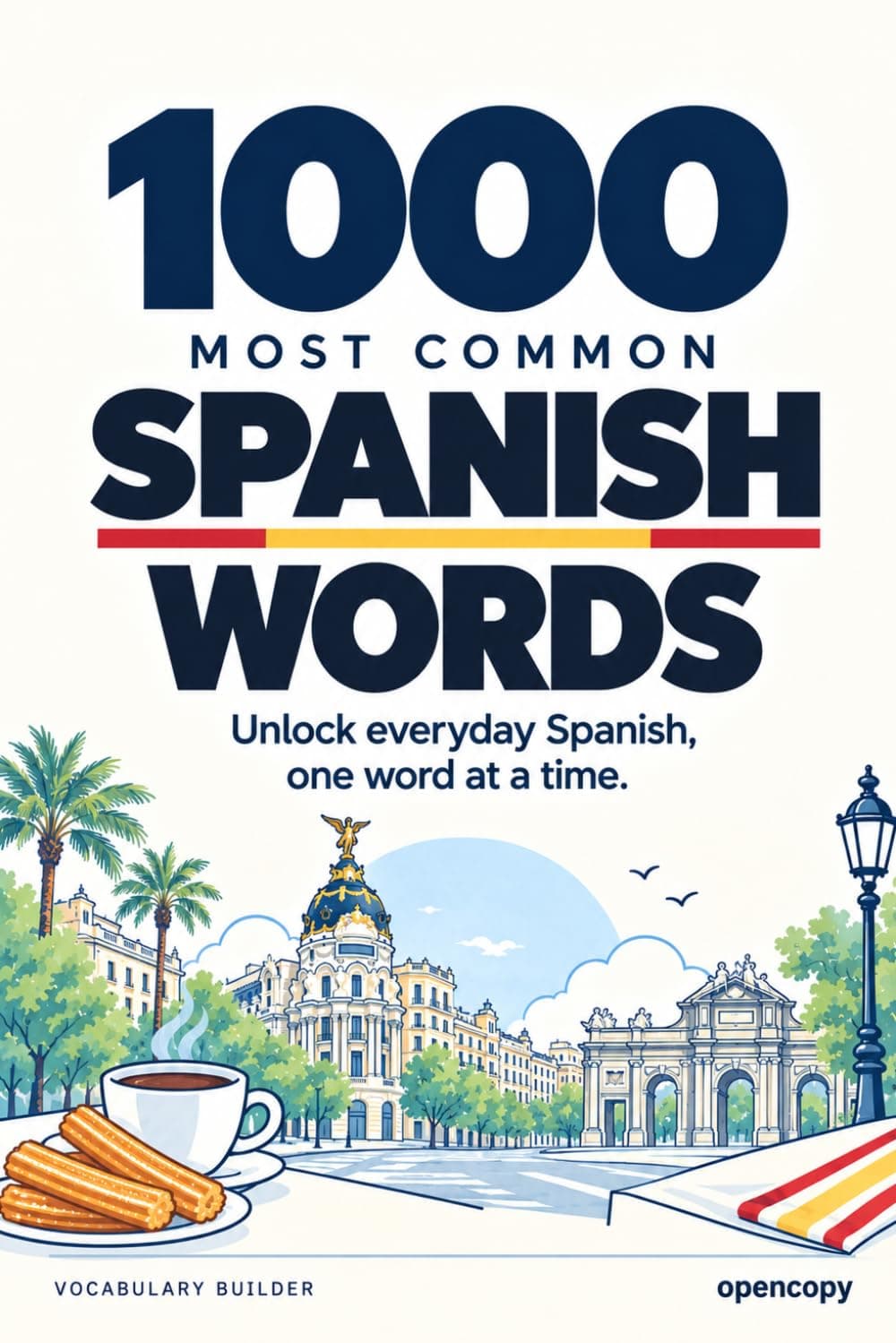
1000 Most Common Spanish Words.
Vocabulary Builder
The 1,000 words that make up about three quarters of the words in everyday written Spanish, grouped by theme and by the patterns that link Spanish to English, each with IPA, an easy English respelling and three example sentences glossed word by word.
238 pages · Paperback & Kindle · Beginner
an example sentence from the entry for tiempo (time, weather)
Patterns, not lists.
One thousand high-frequency words in three Parts: the essential grammar words, the words that look like English, and the rest by theme.
You know more Spanish than you think. Spanish is spelled the way it sounds, and hundreds of its most common words already look familiar because they resemble English: hotel is hotel, familia is family, problema is problem. The 1,000 headwords in this book make up about three quarters of the words in everyday written Spanish, counted by frequency, so they are the place to start.
This frequency reader opens with the small words that hold every sentence together, el and de, que and en, and the workhorse verbs ser, estar, tener, hacer and ir. Part Two gathers 485 words you can read through English: identical twins (hotel, color, idea), the hidden s that turns escuela into school and estado into state, predictable endings like nación and libertad, and words close enough to guess aloud, like problema and montaña. The rest of the thousand follow by everyday theme, from people and family to feelings and ideas, so related words stay together instead of scattering down a frequency list.
Every entry gives the word, its IPA, an easy English respelling with the stressed syllable in capitals and its meaning (with the gender of every noun), then three example sentences glossed word by word, with a natural translation underneath. Four short guides come first: how to pronounce Spanish, a few grammar essentials (ser and estar, the five ways to say you, how me gusta works), the words most likely to fool you (actual means current, largo means long) and the everyday phrases Spanish builds its own way, from tengo hambre (I'm hungry) to me duele la cabeza (my head hurts). Fourteen key irregular verbs carry a conjugation table, every chapter ends with a quick check and each Part with a test, and the answer key and an A–Z dictionary of every word sit at the back.
- 01Start here: the essential wordsThe little words that run almost every sentence, and the workhorse verbs ser, estar, tener, hacer and ir
- 02Identical twinsMore than a hundred words spelled and used almost exactly as in English: hotel, color, animal, idea
- 03The hidden sDrop the e from a word that starts es- plus a consonant, and an English s-word often appears: escuela is school, estado is state
- 04Predictable endingsChange the ending and the English word appears: nación is nation, libertad is liberty, música is music
- 05Easy to recogniseNot identical, but close enough to guess aloud: problema, persona, montaña
- 06By themePeople and family, the body and health, home and work, time and numbers, places, nature and weather, feelings, everyday actions, describing things, talking and thinking, and ideas
- 07Four guides up frontHow to pronounce Spanish, Putting Words Together (a few grammar essentials), Words That Fool You (false friends and double meanings) and Say It the Spanish Way (everyday phrases English builds differently)
- 08Verb tables, checks and testsConjugation tables for 14 key irregular verbs, a quick check after every chapter, a test at the end of each Part, the answer key, and an A–Z dictionary of all 1,000 words
The respellings follow a neutral Latin American pronunciation. A box in the pronunciation guide explains the th sound you will hear in most of Spain, and the grammar pages cover vosotros (Spain) and vos (Argentina, Uruguay and parts of Central America).
Why this edition.
Start from what you know
Nearly half the thousand, 485 words, look like English ones, and learning them in pattern groups turns memorisation into recognition: once you know that escuela is school, especial and estado give themselves away.
Built on frequency
The word list comes from the open-source wordfreq data, counted by dictionary form, so la and los count under el. Together the 1,000 headwords make up about 74.6% of the words in everyday written Spanish, and a running total after every chapter shows the share so far. The book says plainly what that measures: how often the words occur, not how much you will understand.
Say it from the first page
Every word carries its IPA and an easy English respelling you can read aloud, with the stressed syllable in capitals. The pronunciation guide covers the two stress rules, the five pure vowels and the trilled rr, and the accents that tell words apart, like el (the) and él (he).
Warned about the traps
A page of false friends and double meanings catches the words most likely to fool you: actual means current, largo means long, and English time is three words in Spanish, tiempo, vez and hora. A second page shows the everyday phrases Spanish builds its own way, like tengo hambre for I'm hungry and hace frío for it's cold.
Grammar by exposure
Three glossed example sentences per entry show each word at work, verb endings, agreement and word order included. Fourteen key irregular verbs, from ser and estar to decir and saber, add a short table in the present, preterite and future, and every chapter closes with three sentences to put into Spanish, answered at the back.
the three example sentences for tiempo (time, weather). A thousand entries read like this
The details.
- Series
- Vocabulary Builder
- Language pair
- Spanish–English interlinear
- Format
- Paperback & Kindle
- Print length
- 238 pages
- Coverage
- 1,000 headwords, about 74.6% of the words in everyday written Spanish by frequency; 3,000 example sentences
- Level
- Beginner
- Published
- June 2026, revised October 2026
- ASIN
- B0HP7BBDPL
More in Spanish.
Every edition is glossed by hand, word by word, and printed on demand by Amazon.


Learn everyday Spanish one word at a time, with every example glossed word by word.
Buy on Amazon