opencopyInterlinear Books
Look insideHow it worksBlogContact
  • Look inside
  • How it works
  • Blog
  • Contact
Bilingual Bedtime/German songs
ErzählliedStory song

Fuchs, du hast die Gans gestohlen.
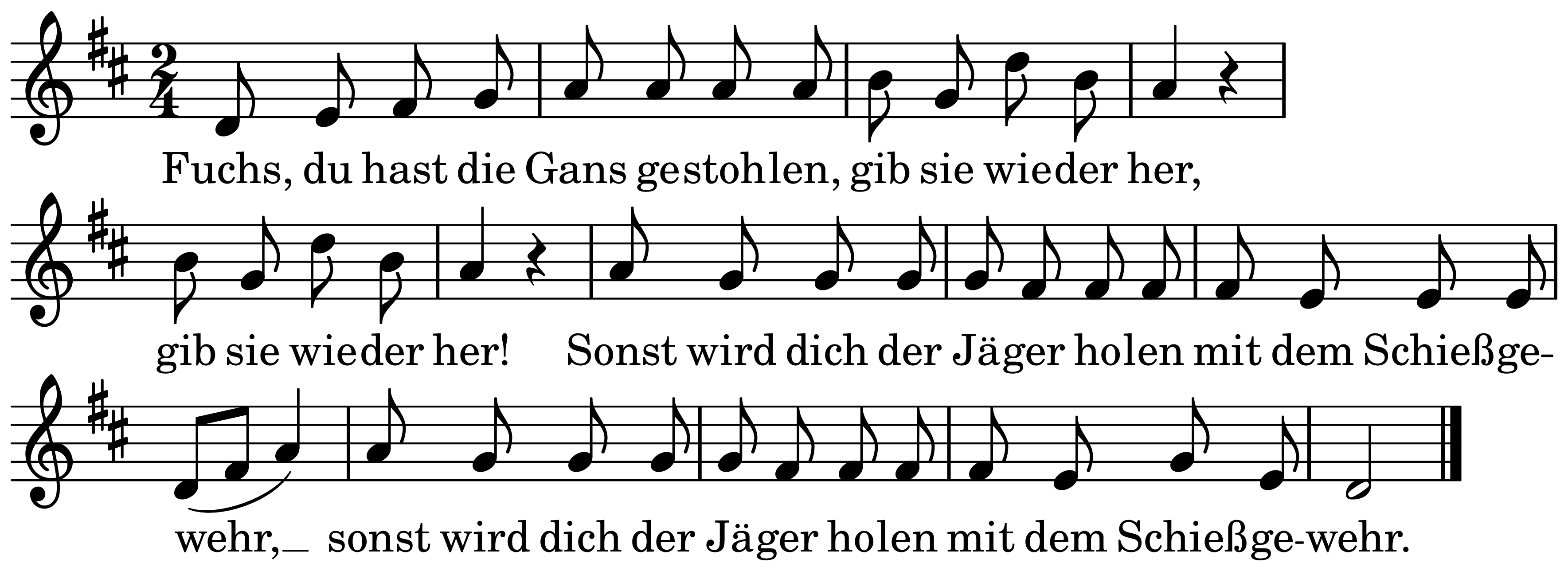
The melody of Fuchs, du hast die Gans gestohlen on a staff, as engraved in the book
Download the tune

The melody as written on the staff, so you can learn the tune before you sing.

Verse 1

  1. Fuchs, du hast die Gans gestohlen, gib sie wieder her,fooks, doo hahst dee gahns guh-shtoh-luhn, geep zee vee-der hair,Fox, you have stolen the goose, give her back,
  2. gib sie wieder her!geep zee vee-der hair!give her back!
  3. Sonst wird dich der Jäger holen mit dem Schießgewehr,zonst virt dikh dair yeh-ger hoh-luhn mit daym shees-guh-vair,Otherwise the hunter will come after you with his gun,
  4. sonst wird dich der Jäger holen mit dem Schießgewehr.zonst virt dikh dair yeh-ger hoh-luhn mit daym shees-guh-vair.otherwise the hunter will come after you with his gun.

Verse 2

  1. Seine große lange Flinte schießt auf dich den Schrot,zai-nuh groh-suh lahng-uh flin-tuh sheest owf dikh dayn shroht,His big long shotgun shoots the lead shot at you,
  2. schießt auf dich den Schrot,sheest owf dikh dayn shroht,shoots the lead shot at you,
  3. dass dich färbt die rote Tinte, und dann bist du tot,dahs dikh fehrpt dee roh-tuh tin-tuh, oont dahn bist doo toht,so that the red ink colors you, and then you are dead,
  4. dass dich färbt die rote Tinte, und dann bist du tot.dahs dikh fehrpt dee roh-tuh tin-tuh, oont dahn bist doo toht.so that the red ink colors you, and then you are dead.

Verse 3

  1. Liebes Füchslein, lass dir raten, sei doch nur kein Dieb,lee-buhs fewks-lain, lahs deer rah-tuhn, zai dokh noor kain deep,Dear little fox, take some advice, do not be a thief,
  2. sei doch nur kein Dieb,zai dokh noor kain deep,do not be a thief,
  3. nimm, du brauchst nicht Gänsebraten, mit der Maus vorlieb,nim, doo browkhst nikht gehn-zuh-brah-tuhn, mit dair mows for-leep,you do not need roast goose, make do with the mouse,
  4. nimm, du brauchst nicht Gänsebraten, mit der Maus vorlieb.nim, doo browkhst nikht gehn-zuh-brah-tuhn, mit dair mows for-leep.you do not need roast goose, make do with the mouse.
About this song

Ernst Anschütz, a Leipzig schoolteacher, wrote these words in 1824 for an older folk tune and called the song Warnung, a warning. It marches, so children stamp the beat. Schießgewehr is an old word for a gun, nothing more, and verse 2 carries the threat out: the shot is fired and the fox is dead.

Where it comes from

The words: Deutscher Liederschatz, "Die schönsten Weisen der alten Sammlung Ludwig Erks, neu bearbeitet und durch hundert Lieder vermehrt" (C. F. Peters, Leipzig, 1920), Edition Peters 10613, Nr. 65 "Warnung", S. 83, headed "Ernst Anschütz, 1824 / 1780-1861" and "Ältere Volksweise".

The tune: The engraving on the song's own source page: Deutscher Liederschatz, Edition Peters 10613 (C. F. Peters, Leipzig, 1920), Nr. 65 "Warnung", S. 83, the voice part above the piano accompaniment, D major, 2/4, marked "Mäßig", three systems, fourteen bars, 46 notes. Every pitch was measured against that page's own staff lines, system by system, rather than eyeballed. Cross-checked degree for degree against the score block in the Melodie section of the de.wikipedia article "Fuchs, du hast die Gans gestohlen" (also D major, written there in 4/4, so one Wikipedia bar equals two of Erk's): the two agree on 44 of the 46 notes, in order. They part only over the third note of "mit dem Schieß-ge-". Peters prints fis e e e the first time round (bar 9) and fis e g e the second (bar 13), where Wikipedia has fis e fis e both times; the two Peters readings differ from each other, which reads as deliberate, the flat bar 9 running into the rising melisma d fis a on "wehr," and the lifted g of bar 13 setting up the final fall g e d. The plate is printed here and both bars were re-read at high magnification. The Liederschatz's own D major is kept, since D lies inside the book's C-to-G range; range d' to d'', one octave. The one deliberate change to the plate is the last note's value, a half here against Peters's quarter plus a quarter rest, so that a one-verse staff ends on a whole bar of sound, which is also what Wikipedia's d1 gives. 44 lyric syllables under 46 notes, the two extra being the melisma on "wehr,"

From the book

Bilingual Bedtime

Thirty-Seven German Songs for Children

Buy paperbackBuy KindleBuy hardcoverAbout this edition
Alle meine EntchenAll 37 songsAlle Vögel sind schon da
opencopy© 2026
Look insideHow it worksBlogAboutJobsContactPrivacyTermsAccessibility