opencopyInterlinear Books
Look insideHow it worksBlogContact
  • Look inside
  • How it works
  • Blog
  • Contact
Bilingual Bedtime/German songs
FestliedFestive song

Kling, Glöckchen.

Lasst mich ein, ihr Kinder
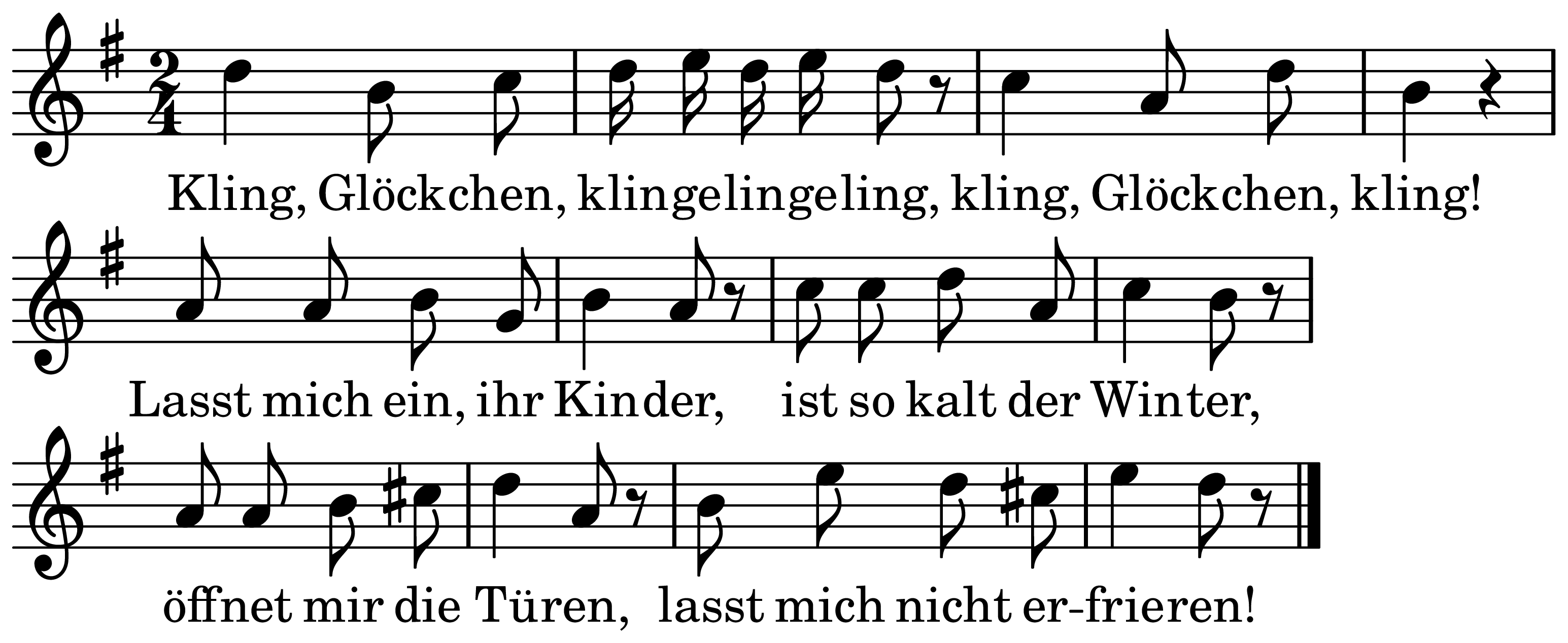
The melody of Kling, Glöckchen on a staff, as engraved in the book
Download the tune

The melody as written on the staff, so you can learn the tune before you sing.

Verse 1

  1. Lasst mich ein, ihr Kinder,lahst mikh ain, eer kin-der,Let me in, you children,
  2. ist so kalt der Winter,ist zoh kahlt dair vin-ter,the winter is so cold,
  3. öffnet mir die Türen,erf-nuht meer dee tew-ruhn,open the doors for me,
  4. lasst mich nicht erfrieren!lahst mikh nikht ehr-free-ruhn!do not let me freeze!

Refrain

  1. Kling, Glöckchen, klingelingeling,kling, glerk-khuhn, klin-guh-lin-guh-ling,Ring, little bell, ring-a-ling-a-ling,
  2. kling, Glöckchen, kling!kling, glerk-khuhn, kling!ring, little bell, ring!

Verse 2

  1. Mädchen hört und Bübchen,meht-khuhn hert oont bewp-khuhn,Girls, listen, and little boys,
  2. macht mir auf das Stübchen!mahkht meer owf dahs shtewp-khuhn!open the little room for me!
  3. Bring euch viele Gaben,bring oykh fee-luh gah-buhn,I bring you many gifts,
  4. sollt euch dran erlaben!zolt oykh drahn ehr-lah-buhn!you shall take delight in them!

Verse 3

  1. Hell erglühn die Kerzchen,hehl ehr-glewn dee kehrts-khuhn,The little candles glow bright,
  2. öffne mir dein Herzchen!erf-nuh meer dain hehrts-khuhn!open your little heart to me!
  3. Will drin wohnen fröhlich!vil drin voh-nuhn frer-likh!I want to live in it happily!
  4. Frommes Kind, wie selig!from-muhs kint, vee zay-likh!Pious child, how blessed!
About this song

Karl Enslin wrote these words in 1854 under the title Christkindchens Einlass: the Christ Child is out in the snow with a little bell and asks to be let in. Sing the refrain first, as the staff sets it, then again after every verse, and ring a real bell on the klingelingeling.

Where it comes from

The words: Karl Enslin, "Christkindchens Einlass" (1854), printed with this tune in Geistlicher Christbaum. 7. Heftchen: Kleinere Weihnachtsspiele, Lieder, Gedichte (Pustet, Regensburg, 1873), Nr. 1 "Christkindchens Ankunft", S. 30 bis 31, the tune credited there "Aus 'H. Oberhoffer' kleinen Sänger".

The tune: The engraving printed over this very text: Geistlicher Christbaum. 7. Heftchen (Pustet, Regensburg, 1873), Nr. 1 "Christkindchens Ankunft", S. 30 bis 31, the tune credited under the last system to "Aus 'H. Oberhoffer' kleinen Sänger" (Heinrich Oberhoffer, Die kleinen Sänger, Luxemburg 1862, its first known printing). Two voices on one staff, G major, 2/4, no upbeat, sixteen bars: refrain, four stanza lines, refrain again. The staff here carries the first twelve of them, the refrain once plus verse 1, 36 notes for 36 syllables. Read at 4000 px page width: the staff lines of each of the six systems were located from a dark-pixel-per-row profile (73.6 px per space), the barlines as full-height dark columns, and every notehead as a blob at least 0.72 of a space wide and 0.60 tall, its centroid converted to a scale degree and each doubtful head re-cropped at 5x to 10x with the pitch rows drawn in. The melody is the upper voice. G major is the print's own key and lies inside the book's C to G range, so it is kept; range G4 to E5. Cross-checked degree for degree against the score block in the Melodie section of the de.wikipedia article "Kling, Glöckchen, klingelingeling" (F major, 2/4, 48 notes), fetched through the MediaWiki API: brought to the same tonic the two agree on 35 of these 36 notes, including the raised fourth on "die" and on "er-" and every bar's syllable count. They part on ONE note, the third of the song, the "-chen" of the opening "Kling, Glöckchen,": Wikipedia has the fourth degree, the print has the tonic g'. The received reading is the one engraved here; see note. The print's own second statement of those three words, three systems later, is harmonised and does read d'' b' c''; the opening statement prints its three notes as unisons and the third head sits squarely on the G4 line with nothing at C5, re-cropped at 10x to be sure. The 1882 Cincinnati reprint of this same setting (H. Liebhart, Liederlust und Psalter, Nr. 176, S. 187 f., archive.org liederlustundpsa00lieb_0, leaves n188 and n189, opened as well) shows the same pair, g' at the opening and c'' at the close, but it is a reprint of this print and so one witness, not two. The print's closing bars also cadence differently from its opening ones, ending on the tonic (c'' a' a' g') where the opening has c'' a' d'' b', which is why this setting's varied refrain has been left as printed rather than quietly emended. That one note has been flipped to the received reading; the print's g' is recorded in the note

From the book

Bilingual Bedtime

Thirty-Seven German Songs for Children

Buy paperbackBuy KindleBuy hardcoverAbout this edition
Morgen kommt der WeihnachtsmannAll 37 songsIhr Kinderlein, kommet
opencopy© 2026
Look insideHow it worksBlogAboutJobsContactPrivacyTermsAccessibility