opencopyInterlinear Books
Look insideHow it worksBlogContact
  • Look inside
  • How it works
  • Blog
  • Contact
Bilingual Bedtime/German songs
FestliedFestive song

Ihr Kinderlein, kommet.

Ihr Kinderlein, kommet, o kommet doch all
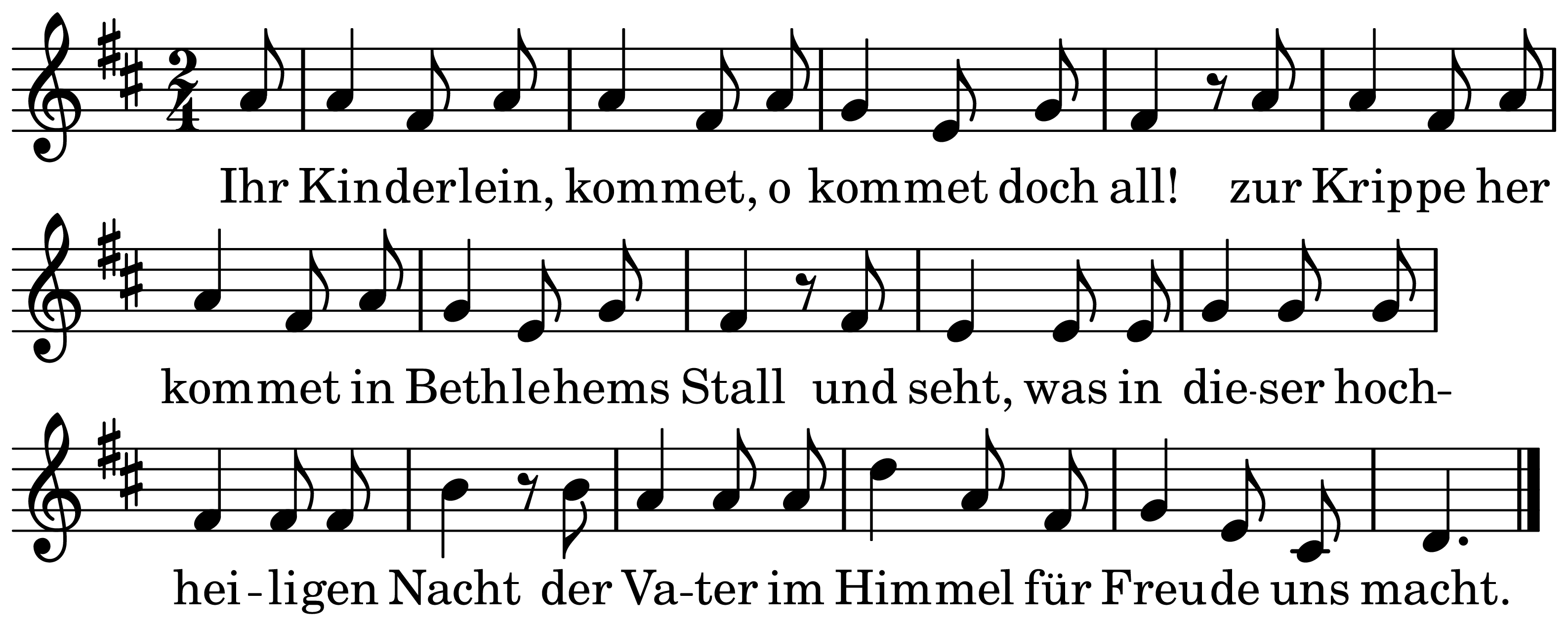
The melody of Ihr Kinderlein, kommet on a staff, as engraved in the book
Download the tune

The melody as written on the staff, so you can learn the tune before you sing.

Verse 1

  1. Ihr Kinderlein, kommet, o kommet doch all!eer kin-der-lain, kom-muht, oh kom-muht dokh ahl!You little children, come, oh do come, all of you!
  2. zur Krippe her kommet in Bethlehems Stalltsoor krip-puh hair kom-muht in bayt-luh-hehms shtahlcome here to the manger in Bethlehem's stable
  3. und seht, was in dieser hochheiligen Nachtoont zayt, vahs in dee-zer hohkh-hai-li-guhn nahkhtand see what joy, on this most holy night,
  4. der Vater im Himmel für Freude uns macht.dair fah-ter im him-muhl fewr froy-duh oons mahkht.the Father in heaven brings us.

Verse 2

  1. O seht in der Krippe im nächtlichen Stall,oh zayt in dair krip-puh im nehkht-li-khuhn shtahl,Oh look in the manger in the night time stable,
  2. seht hier bei des Lichtleins hellglänzendem Strahlzayt heer bai dehs likht-lains hehl-glehn-tsuhn-duhm shtrahllook here by the bright shining beam of the little light
  3. in reinlichen Windeln das himmlische Kind,in rain-li-khuhn vin-duhln dahs him-li-shuh kint,at the heavenly child in clean swaddling clothes,
  4. viel schöner und holder, als Engel es sind.feel sher-ner oont hol-der, ahls ehng-uhl ehs zint.far more beautiful and lovely than angels are.

Verse 3

  1. Da liegt es, ach Kinder, auf Heu und auf Stroh,dah leekt ehs, ahkh kin-der, owf hoy oont owf shtroh,There it lies, oh children, on hay and on straw,
  2. Maria und Joseph betrachten es froh,mah-ree-ah oont yoh-zehf buh-trahkh-tuhn ehs froh,Mary and Joseph look at it gladly,
  3. die redlichen Hirten knien betend davor,dee rayt-li-khuhn hir-tuhn kneen bay-tuhnt dah-fohr,the honest shepherds kneel praying in front of it,
  4. hoch oben schwebt jubelnd der Engelein Chor.hohkh oh-buhn shvaypt yoo-buhlnt dair ehng-uh-lain kohr.high above, the choir of little angels hovers rejoicing.

Verse 4

  1. O beugt, wie die Hirten, anbetend die Knie,oh boykt, vee dee hir-tuhn, ahn-bay-tuhnt dee knee,Oh bend your knees in worship, as the shepherds do,
  2. erhebet die Händlein und danket wie sie!ehr-hay-buht dee hehnt-lain oont dahn-kuht vee zee!raise your little hands and give thanks as they do!
  3. Stimmt freudig, ihr Kinder, wer sollt sich nicht freun?shtimt froy-dikh, eer kin-der, vair zolt zikh nikht froyn?Join in joyfully, you children, who should not be glad?
  4. stimmt freudig zum Jubel der Engel mit ein.shtimt froy-dikh tsoom yoo-buhl dair ehng-uhl mit ain.join in joyfully with the rejoicing of the angels.
About this song

Christoph von Schmid, a Bavarian priest who wrote for children, made this crib poem about 1811. It is sung to a tune Schulz wrote in 1794. Schmid wrote eight verses; this 1920 print gives the four sung here. Kinderlein is the fond old word for little children.

Where it comes from

The words: Christoph von Schmid, "Die Kinder bei der Krippe" (1811), with Johann Abraham Peter Schulz's melody of 1794, printed in Deutscher Liederschatz. Die schönsten Weisen der alten Sammlung Ludwig Erks, neu bearbeitet und durch hundert Lieder vermehrt (C. F. Peters, Leipzig, 1920), Edition Peters 10613, Nr. 152, S. 180 bis 181.

The tune: The engraving printed over this very text: Deutscher Liederschatz (C. F. Peters, Leipzig, 1920), Edition Peters 10613, Nr. 152 "Die Kinder bei der Krippe", S. 180 bis 181, headed "Christoph von Schmid, 1768 bis 1854", the melody attributed in the top right corner to "Johann Abraham Peter Schulz, 1747 bis 1800" and marked "Freudig, doch nicht zu geschwind". Voice part over piano, E flat major, 2/4, an eighth note upbeat, three vocal systems, all sixteen bars written out with no repeat sign. The five staff line rows of each system were measured off a greyscale dump of the scan and every notehead centroid compared with them, so each pitch is read off the engraving; the key signature was enlarged 900 percent and counted (three flats, E flat major, not the four of A flat). Cross-checked against three independent references: the score block in the Melodie und Liedtext section of the de.wikipedia article "Ihr Kinderlein, kommet" (D major, fetched as wikitext with the MediaWiki API), the Carus and SWR2 Liederprojekt sheet lied31672 (D major), and a second pre 1926 print, Unser Liederbuch. Die beliebtesten Kinderlieder (Merck, Darmstadt, 1900), S. 24, page image read at https://archive.org/download/unserliederbuchd01merc/page/n27_w2000.jpg. The Liederschatz agrees with the first two on 42 of its 44 notes and with the 1900 print on 40 of 44. Two divergences, both known. First, the Liederschatz plate alone sets "doch" in line 1 and "hems" in line 2 a third low, as a repeat of the note before (degrees 5 4 2 2 3 where all three references have 5 4 2 4 3); the staff does not follow it, since three references agree against one plate and this book's staff has to be the tune families sing. Second, the 1900 print keeps Schulz's own 1794 stepwise cadence on "für Freude uns macht" while the Liederschatz, Wikipedia and Carus all carry Eickhoff's 1832 cadence; the staff follows the Liederschatz there, three sources to one. The Liederschatz's E flat major lies outside the book's C to G range, so the staff is transposed down a minor second to D major, the key of both the Wikipedia score and the Carus sheet. Range C sharp 4 to D5, a minor ninth

From the book

Bilingual Bedtime

Thirty-Seven German Songs for Children

Buy paperbackBuy KindleBuy hardcoverAbout this edition
Kling, GlöckchenAll 37 songsAlle Jahre wieder
opencopy© 2026
Look insideHow it worksBlogAboutJobsContactPrivacyTermsAccessibility