opencopyInterlinear Books
Look insideHow it worksBlogContact
  • Look inside
  • How it works
  • Blog
  • Contact
Bilingual Bedtime/German songs
ErzählliedStory song

Kuckuck, Kuckuck, ruft's aus dem Wald.

Kuckuck, Kuckuck ruft aus dem Wald
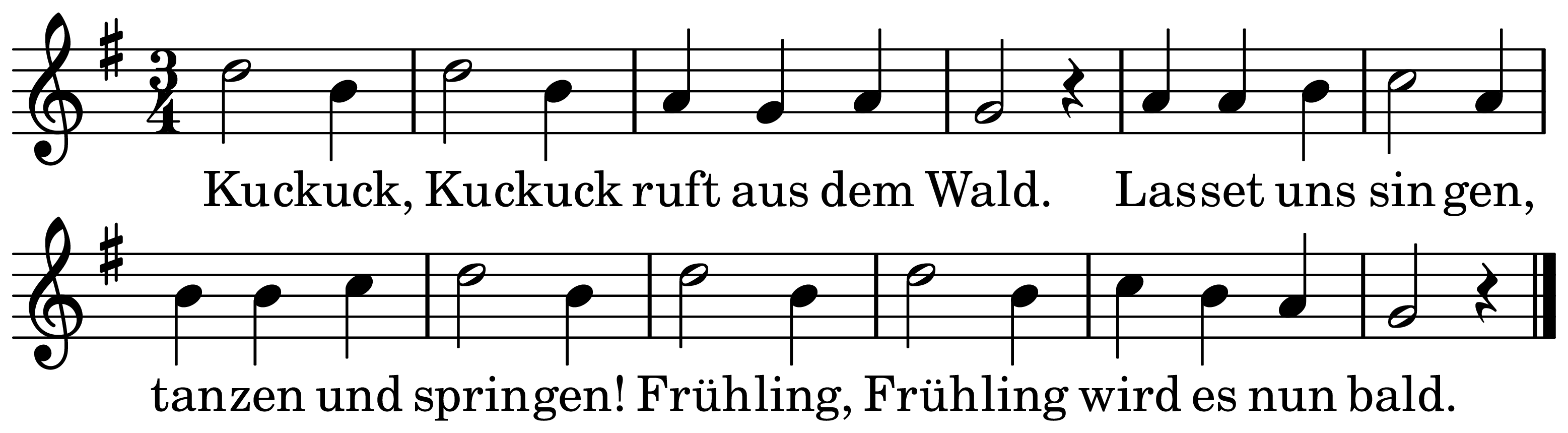
The melody of Kuckuck, Kuckuck, ruft's aus dem Wald on a staff, as engraved in the book
Historische Fassung · Historical version
Download the tune

The melody as written on the staff, so you can learn the tune before you sing.

Verse 1

  1. Kuckuck, Kuckuck ruft aus dem Wald.koo-kook, koo-kook rooft ows daym vahlt.Cuckoo, cuckoo calls from the wood.
  2. Lasset uns singen, tanzen und springen!lahs-suht oons zing-uhn, tahn-tsuhn oont shpring-uhn!Let us sing, dance and leap!
  3. Frühling, Frühling wird es nun bald.frew-ling, frew-ling virt ehs noon bahlt.Spring, spring it will soon be.

Verse 2

  1. Kuckuck, Kuckuck lässt nicht sein Schrei'n:koo-kook, koo-kook lehst nikht zain shrain:Cuckoo, cuckoo does not stop his calling:
  2. Komm in die Felder, Wiesen und Wälder!kom in dee fehl-der, vee-zuhn oont vehl-der!Come into the fields, meadows and woods!
  3. Frühling, Frühling stelle dich ein!frew-ling, frew-ling shtehl-luh dikh ain!Spring, spring, come along now!

Verse 3

  1. Kuckuck, Kuckuck, trefflicher Held!koo-kook, koo-kook, trehf-likh-er hehlt!Cuckoo, cuckoo, you splendid hero!
  2. Was du gesungen, ist dir gelungen:vahs doo guh-zoong-uhn, ist deer guh-loong-uhn:What you sang has succeeded for you:
  3. Winter, Winter räumet das Feld.vin-ter, vin-ter roy-muht dahs fehlt.Winter, winter is retreating from the field.
About this song

Hoffmann von Fallersleben wrote these words by 1837; from 1843 they were printed to this Lower Austrian folk tune, which is older than the song. Walk it, one step to a beat, and call the two Kuckuck notes like the bird. Hoffmann's own page reads ruft aus dem Wald; the ruft's families sing today came later.

Where it comes from

The words: Hoffmann von Fallersleben, Funfzig Kinderlieder, Nr. 2 "Frühlingsbotschaft", nach Original- und bekannten Weisen mit Clavierbegleitung von Ernst Richter, achte Stereotyp-Ausgabe (Haendcke und Lehmkuhl, Hamburg, 1884), S. 2.

The tune: Hoffmann's own print engraves the tune over the words, so the reference is the source's own staff: Funfzig Kinderlieder, Nr. 2 "Frühlingsbotschaft", S. 2, headed "Heiter." and, at the right, "Niederösterreichische Volksweise.", the voice part above Ernst Richter's piano accompaniment, two systems, G major, 3/4 (archive.org bub_gb_UAYRAAAAYAAJ, page image n5_w1000.jpg). Every note is read off that engraving: pitches measured against the staff lines of the page image, values off the open and filled noteheads. Hoffmann's G major lies inside the book's C-to-G range, so his key is kept; range g' to d'', a fifth, and the tune uses only seconds and falling thirds. Cross-checked degree for degree against the score block in the Melodie section of the de.wikipedia article "Kuckuck, Kuckuck, ruft's aus dem Wald" (also G major, 3/4, after Stork, Grosser Schulliederschatz, Gütersloh 1868): the two agree on all 26 pitches, in order. They part only over two rhythmic spellings, and this staff prints Hoffmann's: bars 1 and 2 are a half plus a quarter where Wikipedia writes quarter, quarter, quarter rest, and the two cadence bars (4 and 12) are a half plus a quarter rest where Wikipedia writes a dotted half. Both fill the same 3/4 bar and carry the same syllables. 26 notes = the 26 syllables of verse 1, and of verses 2 and 3

From the book

Bilingual Bedtime

Thirty-Seven German Songs for Children

Buy paperbackBuy KindleBuy hardcoverAbout this edition
Ein Männlein steht im WaldeAll 37 songsSumm, summ, summ
opencopy© 2026
Look insideHow it worksBlogAboutJobsContactPrivacyTermsAccessibility