opencopyInterlinear Books
Look insideHow it worksBlogContact
  • Look inside
  • How it works
  • Blog
  • Contact
Bilingual Bedtime/German songs
ErzählliedStory song

Der Kuckuck und der Esel.
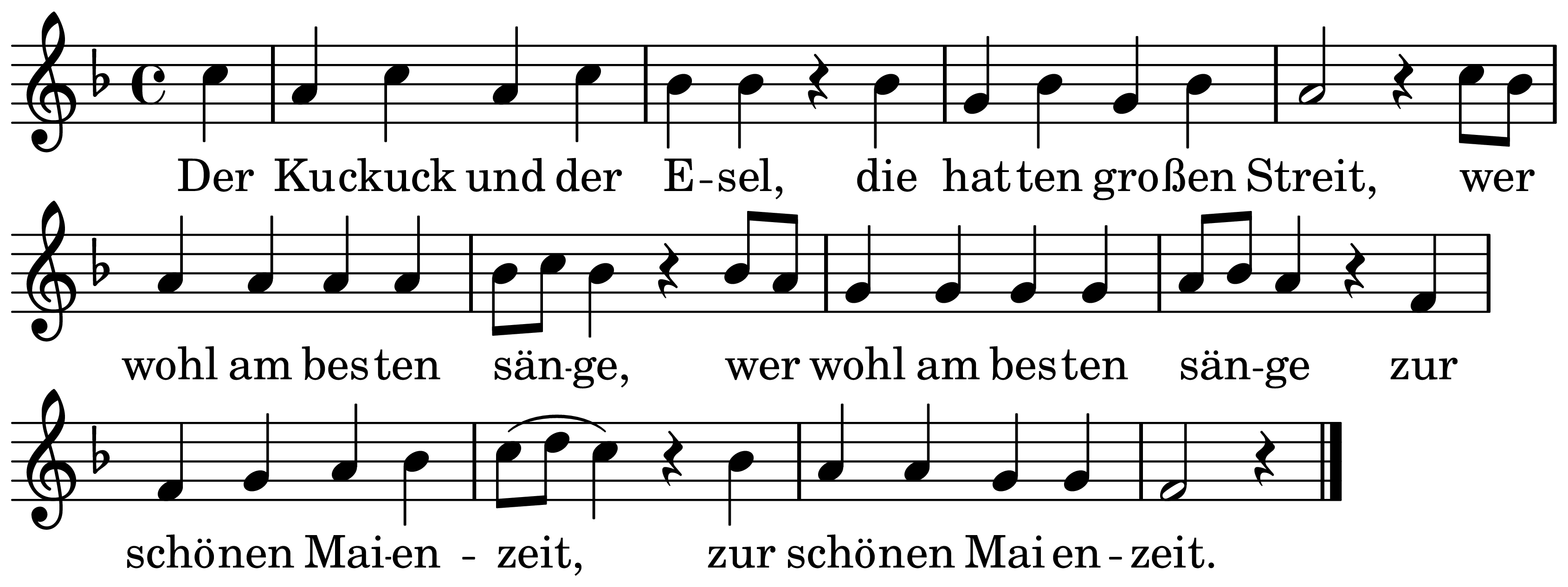
The melody of Der Kuckuck und der Esel on a staff, as engraved in the book
Download the tune

The melody as written on the staff, so you can learn the tune before you sing.

Verse 1

  1. Der Kuckuck und der Esel,dair koo-kook oont dair ay-zuhl,The cuckoo and the donkey,
  2. die hatten großen Streit,dee haht-tuhn groh-suhn shtrait,they had a great quarrel,
  3. wer wohl am besten sänge,vair vohl ahm behs-tuhn zehng-uh,over who could sing the best,
  4. wer wohl am besten sängevair vohl ahm behs-tuhn zehng-uhover who could sing the best
  5. zur schönen Maienzeit,tsoor sher-nuhn mai-uhn-tsait,in the lovely time of May,
  6. zur schönen Maienzeit.tsoor sher-nuhn mai-uhn-tsait.in the lovely time of May.

Verse 2

  1. Der Kuckuck sprach: „Das kann ich!“dair koo-kook shprahkh: „dahs kahn ikh!“The cuckoo said: “that I can do!”
  2. und hub gleich an zu schrei'n.oont hoop glaikh ahn tsoo shrain.and struck up at once with his cry.
  3. „Ich aber kann es besser!„ikh ah-ber kahn ehs behs-ser!“But I can do it better!
  4. ich aber kann es besser!“ikh ah-ber kahn ehs behs-ser!“but I can do it better!”
  5. fiel gleich der Esel ein,feel glaikh dair ay-zuhl ain,the donkey broke straight in,
  6. fiel gleich der Esel ein.feel glaikh dair ay-zuhl ain.the donkey broke straight in.

Verse 3

  1. Das klang so schön und lieblich,dahs klahnk zoh shern oont leep-likh,That sounded so fine and lovely,
  2. so schön von fern und nah:zoh shern fon fehrn oont nah:so fine from far and near:
  3. Sie sangen alle beide,zee zahng-uhn ahl-luh bai-duh,They both of them sang away,
  4. sie sangen alle beidezee zahng-uhn ahl-luh bai-duhthey both of them sang away
  5. Kuku kuku ia!koo-koo koo-koo ee-ah!Cuckoo cuckoo hee-haw!
  6. Kuku kuku ia!koo-koo koo-koo ee-ah!Cuckoo cuckoo hee-haw!

About this song

Hoffmann von Fallersleben wrote the words in 1835, and his own songbook of 1884 sets them to Carl Friedrich Zelter's tune of 1810 under the title Wettstreit, a singing match. Hub is the old past of anheben, struck up. Call the two Kuckuck notes like the bird and bray the last line of each verse.

Where it comes from

The words: Hoffmann von Fallersleben, Funfzig Kinderlieder, Nr. 11 "Wettstreit", nach Original- und bekannten Weisen mit Clavierbegleitung von Ernst Richter, achte Stereotyp-Ausgabe (Haendcke und Lehmkuhl, Hamburg, 1884), S. 13.

The tune: Hoffmann's own print engraves the tune over the words, so the reference is the source's own staff: Funfzig Kinderlieder, Nr. 11 "Wettstreit", S. 13, headed "Mäßig geschwind." at the left and, at the right, "Melodie von C. F. Zelter."; the voice part sits above Ernst Richter's piano accompaniment, two systems, E flat major, common time (archive.org bub_gb_UAYRAAAAYAAJ, page image n16_w1000.jpg). Every note is read off that engraving: the key signature counted at the clef (three flats: B, E and A), pitches measured against the staff lines of the page image, note values off the filled, open and beamed noteheads, barlines located by their full-staff-height ink. E flat major lies outside the book's C to G range, so the tune is transposed up a major second to F major and nothing else is changed; range f' to d'', a sixth. Cross-checked degree for degree against the score block in the Melodie section of the de.wikipedia article "Der Kuckuck und der Esel" (also F major, 4/4, after Zelter's 1810 setting of Goethe's Es ist ein Schuss gefallen): every pitch of the skeleton agrees, bar for bar. They part in three places and this staff prints Hoffmann's: bar 6 beams a passing c'' between the two B flats on sän, bar 8 beams the same ornament a step lower between the two a's, and bar 10 sets zeit as c''8 d''8 c''4 under one slur and then a quarter rest, where Wikipedia writes c''4. d''8 c''4 and no rest. All three still fill 4/4 and carry the same syllables. 45 notes for the 39 sung syllables of verse 1, and of verses 2 and 3

From the book

Bilingual Bedtime

Thirty-Seven German Songs for Children

Buy paperbackBuy KindleBuy hardcoverAbout this edition
Summ, summ, summAll 37 songsKommt ein Vogel geflogen
opencopy© 2026
Look insideHow it worksBlogAboutJobsContactPrivacyTermsAccessibility