opencopyInterlinear Books
Look insideHow it worksBlogContact
  • Look inside
  • How it works
  • Blog
  • Contact
Bilingual Bedtime/German songs
ErzählliedStory song

Kommt ein Vogel geflogen.
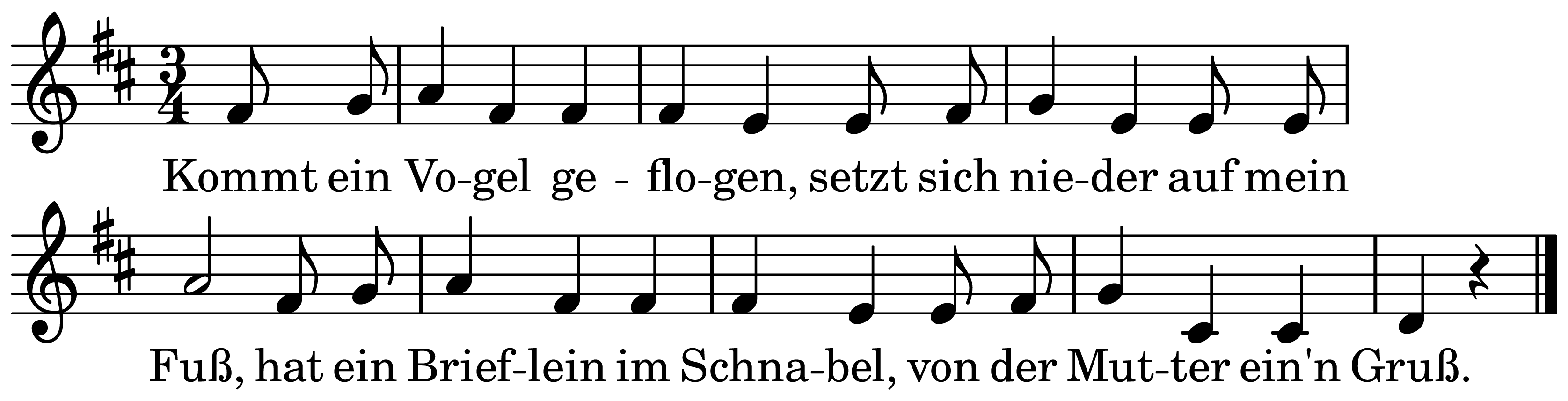
The melody of Kommt ein Vogel geflogen on a staff, as engraved in the book
Download the tune

The melody as written on the staff, so you can learn the tune before you sing.

Verse 1

  1. Kommt ein Vogel geflogen,komt ain foh-guhl guh-floh-guhn,A bird comes flying,
  2. setzt sich nieder auf mein Fuß,zehtst zikh nee-der owf main foos,and settles down on my foot,
  3. hat ein Brieflein im Schnabel,haht ain breef-lain im shnah-buhl,it has a little letter in its beak,
  4. von der Mutter ein'n Gruß.fon dair moot-ter ainn groos.a greeting from Mother.

Verse 2

  1. Lieber Vogel, flieg' weiter,lee-ber foh-guhl, fleek vai-ter,Dear bird, fly on,
  2. nimm ein Gruß mit und ein'n Kuss!nim ain groos mit oont ainn koos!take a greeting with you and a kiss!
  3. Ach, ich kann dich nicht begleiten,ahkh, ikh kahn dikh nikht buh-glai-tuhn,Oh, I cannot go with you,
  4. weil ich hier bleiben muss.vail ikh heer blai-buhn moos.because I have to stay here.
About this song

A Vienna stage hit of 1824, where the bird carried a note from a sweetheart. This Baden book of 1914 has it from the mother. Brieflein is a little letter, and ein'n is einen squeezed onto one note. Let a hand fly in and land on the child's foot. Mein Fuß and ein Gruß are folk dialect forms of meinen Fuß and einen Gruß.

Where it comes from

The words: Badisches Liederbuch für die Schule und Familie, bearbeitet und herausgegeben von Otto Autenrieth, Erstes Heft - Unterstufe (Erstes bis drittes Schuljahr), Fünfte Auflage (Konkordia A.-G., Bühl in Baden, o. J. [um 1914]), S. 45, Nr. 51 "Der Gruß".

The tune: The engraving of the source print itself, which carries verse 1's own syllables under the staff: Badisches Liederbuch für die Schule und Familie, hrsg. von Otto Autenrieth, Erstes Heft - Unterstufe, Fünfte Auflage (Konkordia A.-G., Bühl in Baden, o. J. [um 1914]), S. 45, Nr. 51 "Der Gruß", D major, 3/4, marked "Recht leicht." with a p, headed "Nach einer österreichischen Tanzweise 1822. Von Wenzel Müller, 1767-1835." Three systems, one voice, no accompaniment. Every pitch was measured against the five staff lines of the page image (rows found at y = 184.5 / 194.5 / 203.5 / 213.5 / 222.5 for system 1, the same spacing below) and every value read off the noteheads, stems and flags. Cross-checked degree for degree against the score block in the Melodie section of the de.wikipedia article "Kommt ein Vogel geflogen" (F major, 3/4, partial 4): brought to the same tonic the two agree on 26 of the 27 pitches, in order. The one divergence is the last note of bar 3, on "mein": the Badisches print keeps it on degree 2, level with "der auf", where Wikipedia leaps to degree 6; the print's notehead sits squarely on the bottom staff line at the same height as the two before it and is a flagged eighth like them, so the print's reading is engraved here. The other difference is notation, not sound: "Fuß" is a half note in the print where Wikipedia writes a quarter plus a quarter rest, and both fill the same 3/4 bar on one syllable. The print's own D major is kept, since D is inside the book's C-to-G range; range cis' to a', a sixth. 27 notes for the 27 syllables of verse 1

From the book

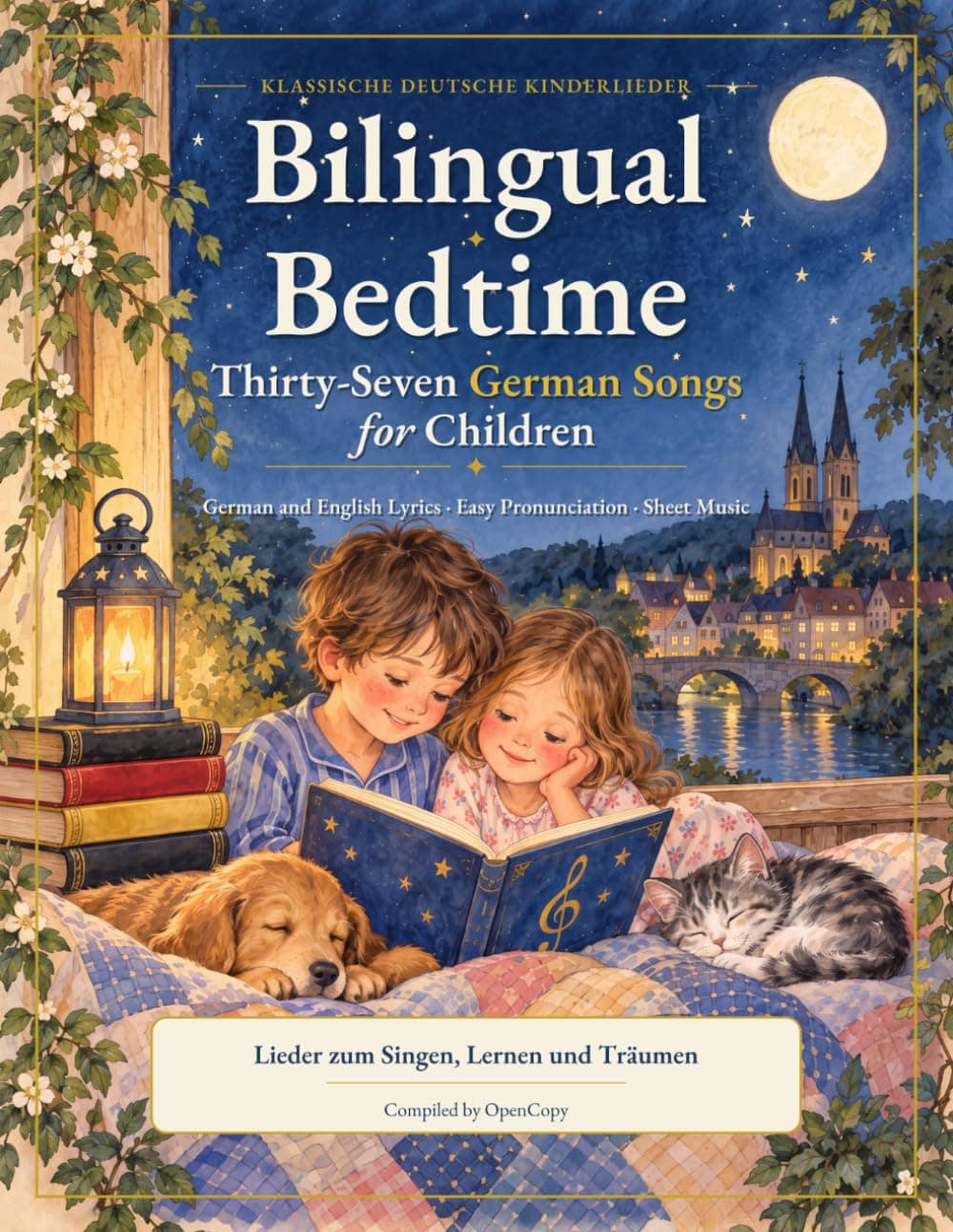
Bilingual Bedtime

Thirty-Seven German Songs for Children

Buy paperbackBuy KindleBuy hardcoverAbout this edition
Der Kuckuck und der EselAll 37 songsEs klappert die Mühle am rauschenden Bach
opencopy© 2026
Look insideHow it worksBlogAboutJobsContactPrivacyTermsAccessibility