opencopyInterlinear Books
Look insideHow it worksBlogContact
  • Look inside
  • How it works
  • Blog
  • Contact
Bilingual Bedtime/German songs
FestliedFestive song

Leise rieselt der Schnee.
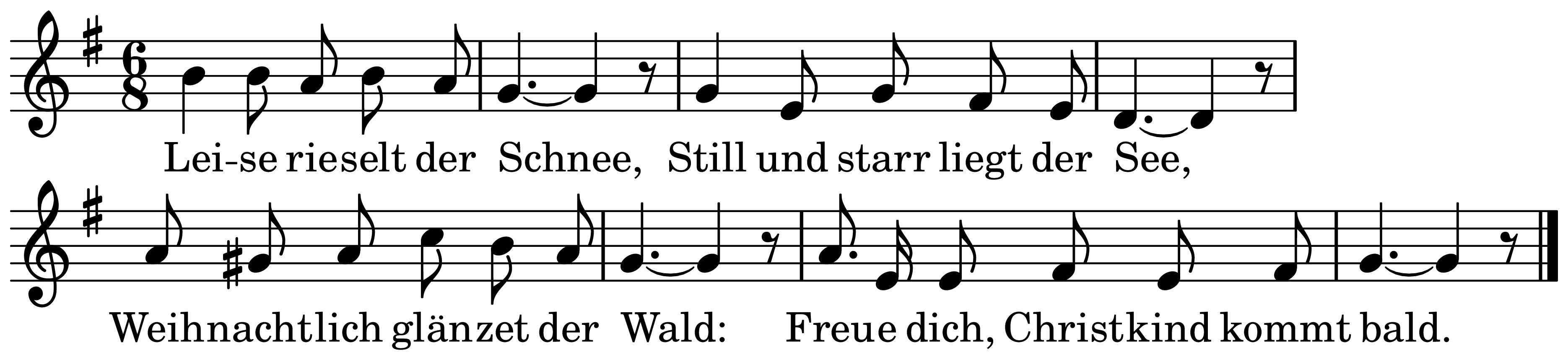
The melody of Leise rieselt der Schnee on a staff, as engraved in the book
Download the tune

The melody as written on the staff, so you can learn the tune before you sing.

Verse 1

  1. Leise rieselt der Schnee,lai-zuh ree-zuhlt dair shnay,Softly the snow trickles down,
  2. Still und starr liegt der See,shtil oont shtahr leekt dair zay,still and frozen lies the lake,
  3. Weihnachtlich glänzet der Wald:vai-nahkht-likh glehn-tsuht dair vahlt:the forest shines with Christmas:
  4. Freue dich, Christkind kommt bald.froy-uh dikh, krist-kint komt bahlt.Rejoice, the Christ child is coming soon.
Verse 2

  1. In den Herzen ist's warm,in dayn hehr-tsuhn ists vahrm,In our hearts it is warm,
  2. Still schweigt Kummer und Harm,shtil shvaikt koom-mer oont hahrm,sorrow and grief fall quiet,
  3. Sorge des Lebens verhallt:zor-guh dehs lay-buhns fer-hahlt:the care of living dies away:
  4. Freue dich, Christkind kommt bald.froy-uh dikh, krist-kint komt bahlt.Rejoice, the Christ child is coming soon.

Verse 3

  1. Bald ist heilige Nacht;bahlt ist hai-li-guh nahkht;Soon it is holy night;
  2. Chor der Engel erwacht;kohr dair ehng-uhl ehr-vahkht;the choir of angels wakes;
  3. Horch' nur, wie lieblich es schallt:horkh noor, vee leep-likh ehs shahlt:Just listen, how sweetly it rings out:
  4. Freue dich, Christkind kommt bald.froy-uh dikh, krist-kint komt bahlt.Rejoice, the Christ child is coming soon.

About this song

Eduard Ebel, a pastor in Graudenz, printed these three stanzas in 1895 under the title Weihnachtsgruß and called them simply a children's song. Rieseln is the quiet trickling fall of dry snow. The Christkind is the gift bringer German children wait for at Christmas.

Where it comes from

The words: Eduard Ebel, "Weihnachtsgruß. 1895. Ein Kinderlied.", in Gesammelte Gedichte von Eduard Ebel (Gustav Röthe's Buchdruckerei, Graudenz, 1895), S. 86.

The tune: Ebel's own 1895 print carries the words only, with no engraving, so the tune comes from two later references that agree note for note. First, the <score> block in the Melodie section of the de.wikipedia article "Leise rieselt der Schnee", fetched as wikitext with the MediaWiki API: G major, 6/8, no upbeat, eight bars. Second, the engraved sheet in the Liederprojekt of SWR2 and the Carus-Verlag, Nr. 40 "Leise rieselt der Schnee", from the Weihnachtslieder-Buch of Carus and Reclam, headed "Melodie und Text: Eduard Ebel (1839-1905) 1895", also G major, 6/8, two systems of four bars. The Liederprojekt PDF was rendered at 600 dpi, the five staff lines of each system located by counting dark pixels per row (19.25 px to the scale step), the note heads isolated by eroding the page with a 27x15 window so that staff lines, stems and flags drop out, and each head's centroid converted to a scale degree against its own system's lines. Read off that way the sheet gives B B A B A / G tied G / G E G fis E / D tied D / A gis A C B A / G tied G / A E E fis E fis / G tied G, which is the de.wikipedia score degree for degree on all 26 notes, in the same key and metre, tied line ends and filling eighth rests included. G major lies inside the book's C to G range and is kept, untransposed; range D4 to C5. The two references differ only in the words underlaid: Carus sings "ruht der See" where Ebel's print has "liegt der See", and the print is what is underlaid here

From the book

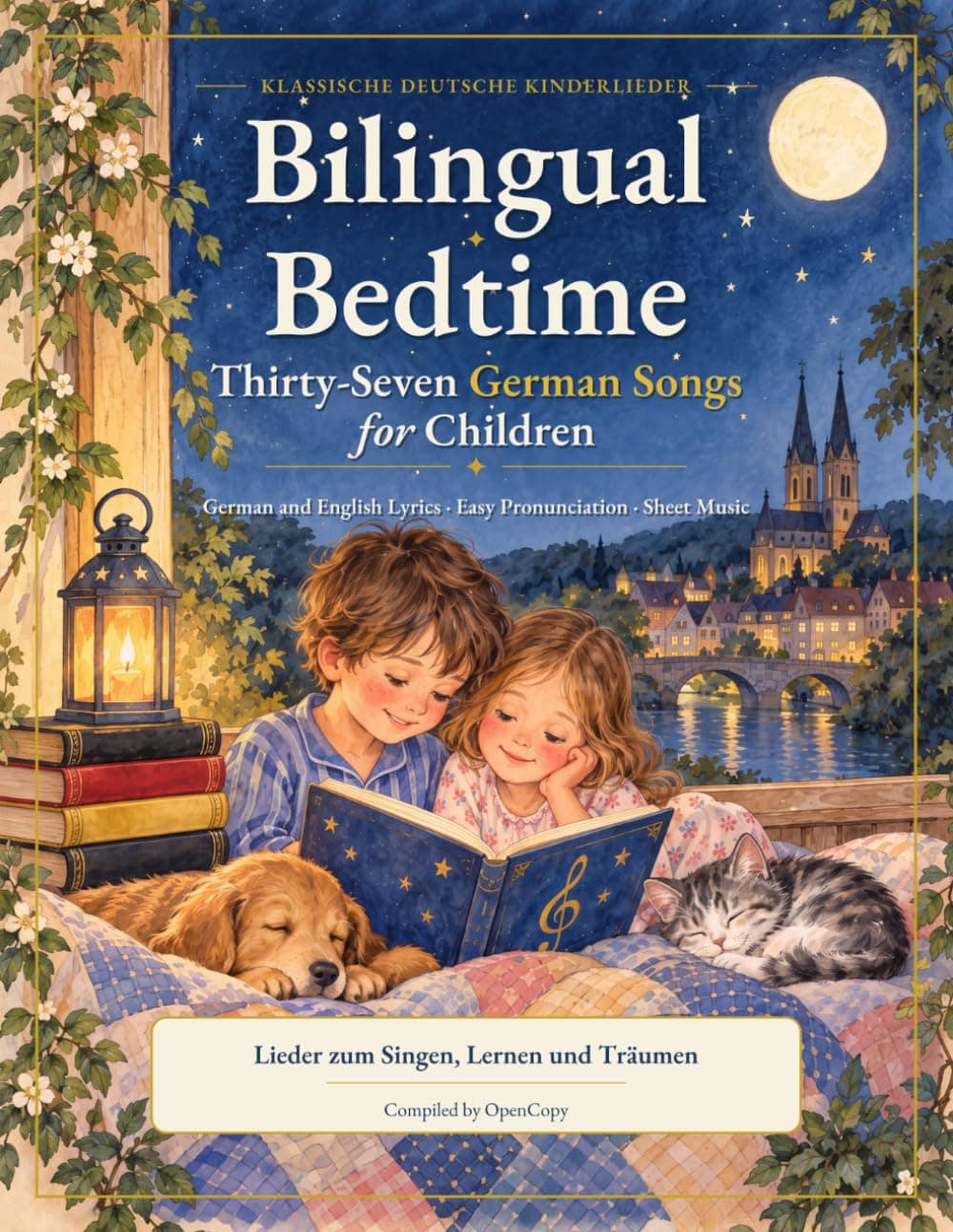
Bilingual Bedtime

Thirty-Seven German Songs for Children

Buy paperbackBuy KindleBuy hardcoverAbout this edition
O TannenbaumAll 37 songsWer hat die schönsten Schäfchen
opencopy© 2026
Look insideHow it worksBlogAboutJobsContactPrivacyTermsAccessibility