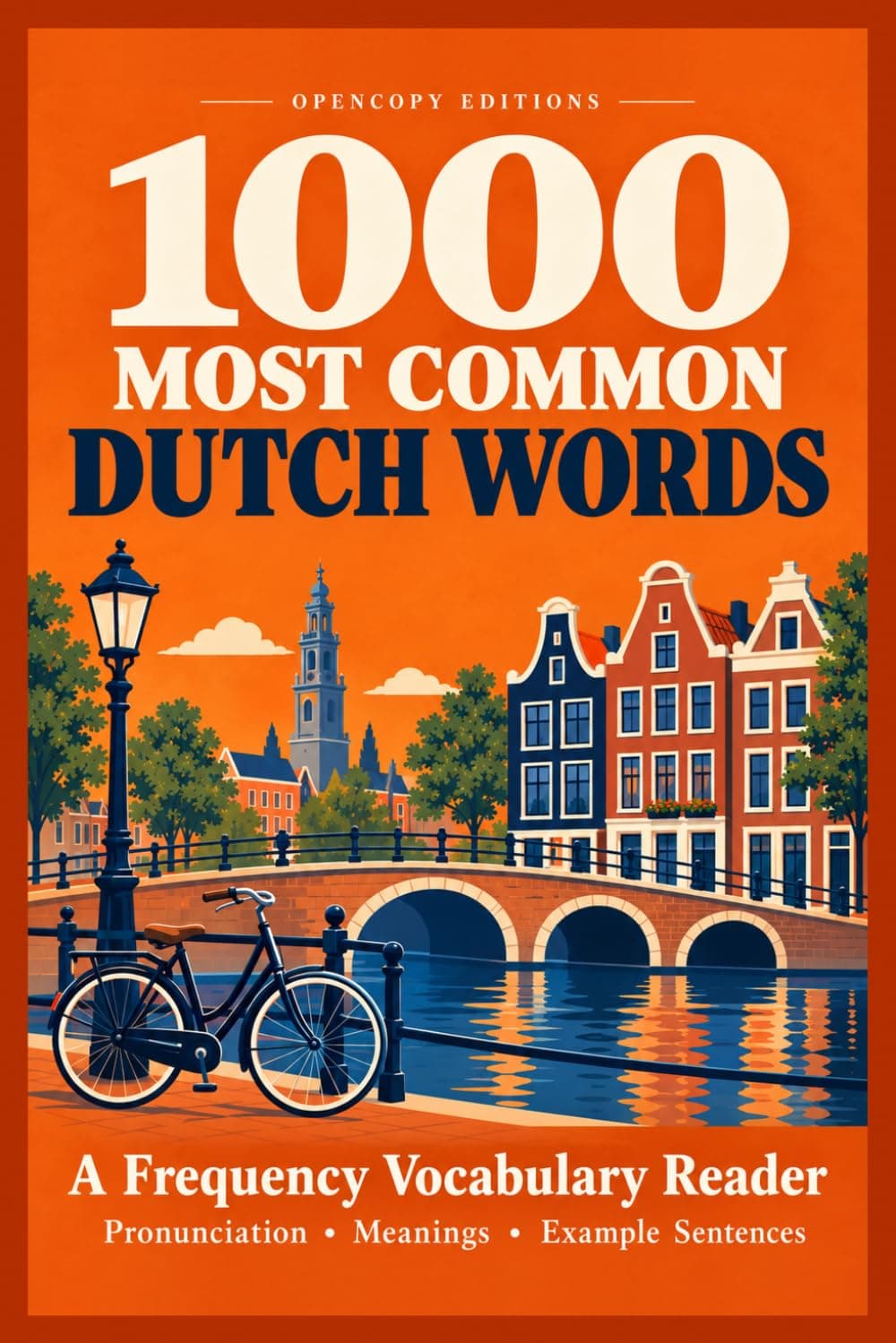
1000 Most Common Dutch Words.
Frequency Vocabulary Reader
The 1,000 words behind an estimated 77.2% of word occurrences in modern Dutch, grouped by pattern and everyday theme, with IPA, a plain-English respelling, de or het for every noun and three interlinear example sentences per entry.
328 pages · Paperback & Kindle · Beginner
an example sentence from the entry for vader (father)
How the book is organised.
One thousand high-frequency words in three Parts and 40 chapters, from the glue words to the ones English has already taught you to the rest by theme.
Dutch is one of English's closest relatives: vader means father, huis means house, and many words look familiar at first sight. The real work lies elsewhere, in de and het, which are learned noun by noun, and in a word order that sends the verb to second place or to the very end of the clause. Vocabulary is the place to start, and a small core does most of the work. In the frequency data behind this book, a blend of subtitles, news, web pages, Wikipedia and social media, these 1,000 headwords account for an estimated 77.2% of word occurrences.
The book opens with the glue of every sentence: the pronouns, zijn and hebben, the prepositions, the joining words and the small adverbs, with a chapter on the er and daar words that point back (ervan, daarmee, waarop). Part Two is where Dutch pays you back for knowing English. Spelling clues link denken to think, vader to father and huis to house, borrowed endings match -tie to -tion and -teit to -ty, and whole chapters gather identical twins and close cousins: 386 of the thousand in all. The rest come by everyday theme, from people and places to work, feelings and talk, so related words stay together.
Every entry gives the word, its IPA and a plain-English respelling with the stressed syllable in capitals, and its meaning, with de or het and the plural for every noun. Three example sentences follow, each glossed word by word beneath the Dutch with a natural translation underneath. Forty-six verb tables give the present and past of the key strong and irregular verbs. Each Part ends with a short test, and the answer key and an alphabetical glossary sit at the back.
- 01Start here: the essential wordsPronouns and the core verbs, question words, articles and numbers, prepositions, joining words, the words that point back, and the small adverbs
- 02Words you already knowSpelling clues that link Dutch to English (d and th, v and f, z and s, then the vowel and consonant clues), borrowed endings like -tie and -teit, identical twins and close cousins
- 03By themePeople and the body, time, places and the home, countries and languages, work and money, feelings, everyday actions, describing words, talking and thinking, and ideas
- 04Three sentences per entryWord-by-word English glosses beneath the Dutch, in the Dutch word order, with a natural translation underneath
- 05Pronunciation and grammar up frontReading the respellings, the throaty g and the vowels English lacks, de and het, verb-second word order, separable verbs, word building with -je, -heid and -lijk, numbers and the half-hour trap on the clock, and a short list of false friends
- 06Tests, answer key and glossaryA test at the end of each Part, answers at the back, and every word in Dutch alphabetical order
A bonus chapter before the answers, If You Already Know German, turns school German into a head start: ten rules that turn a German word into its Dutch cousin, 60 word pairs and 12 false friends.
Why this edition.
Built on frequency
These 1,000 headwords cover an estimated 77.2% of word occurrences in modern Dutch, counting every form each one stands for (huis and huizen, ga and ging), so your early effort lands on the words you will meet everywhere.
Start from what you know
Dutch and English are close relatives, and Part Two puts that to work. Spelling clues link denken to think and vader to father, borrowed endings match -tie to -tion, and identical twins like water, hand and school are spelled just as they are in English: 386 of the thousand words sit in this Part.
De or het, every time
The choice between de and het is learned noun by noun, so every noun carries its article and its plural. The grammar pages up front give three rules of thumb that help: about two thirds of nouns are de-words, every -je diminutive is het, and every plural takes de.
Say it from the first page
Every word carries IPA for precision and a plain-English respelling you can read aloud, with the stressed syllable in capitals. The pronunciation key covers the throaty g, the vowels English does not have and the w that is not quite an English w, with a note on how Belgian Dutch differs.
Word order you can see
The glosses follow the Dutch word for word, so you watch the verb take second place: Na school gaat Bram meteen naar huis is after school goes Bram immediately to home. A short grammar section up front explains why, along with separable verbs and when the perfect takes zijn.
example sentences from the entries for vader, huis and nacht in Part Two, Words You Already Know. A thousand entries read like this
The details.
- Series
- OpenCopy Editions
- Language pair
- Dutch–English interlinear
- Format
- Paperback & Kindle
- Print length
- 328 pages
- Coverage
- 1,000 headwords (≈77.2% of word occurrences), 3,000 example sentences
- Level
- Beginner
- Published
- October 2026
- ASIN
- B0HLY9YVCQ
More from the press.
Every edition is glossed by hand, word by word, and printed on demand by Amazon.
Learn the 1,000 words at the heart of everyday Dutch, with every example glossed word by word.
Buy on Amazon