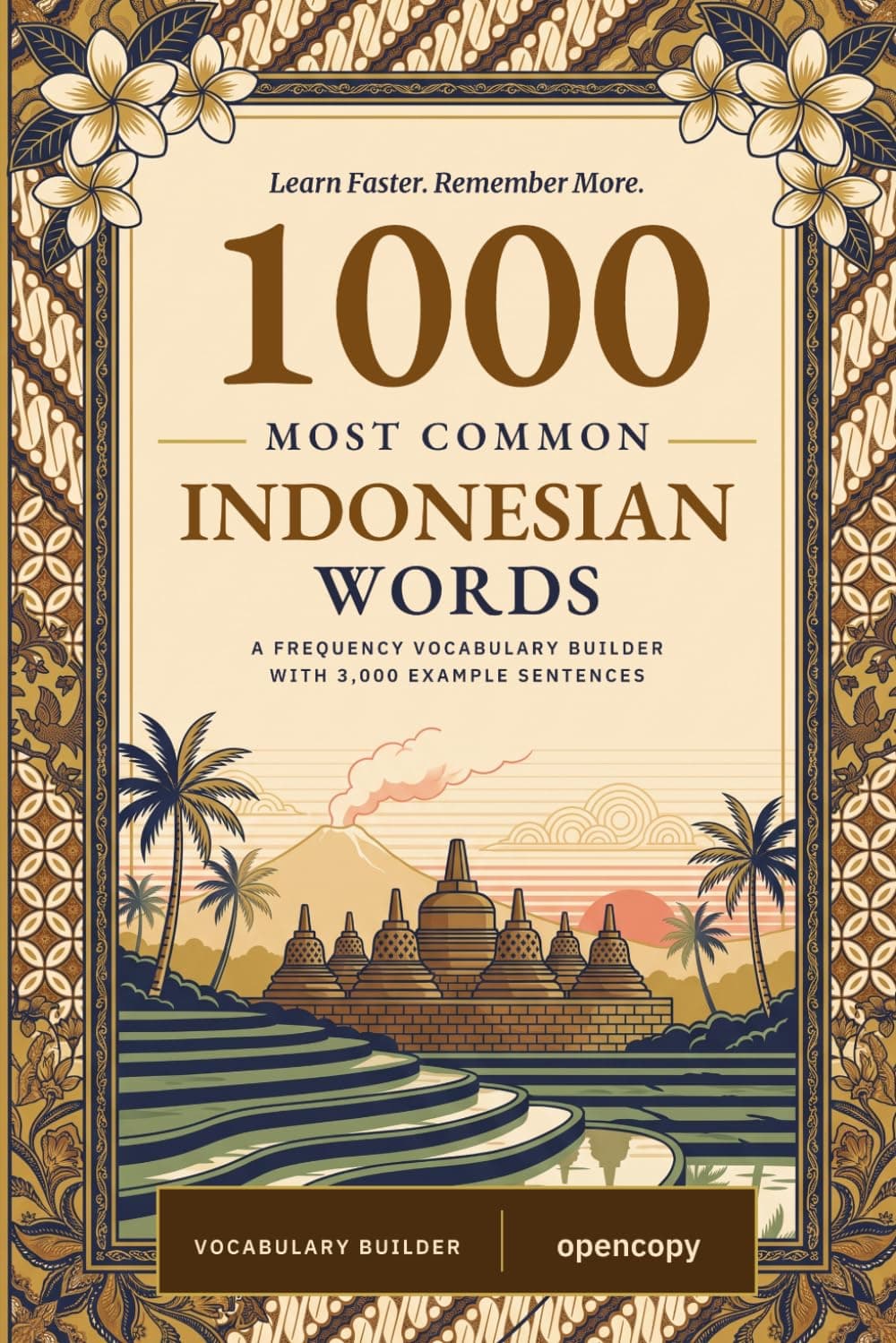
1000 Most Common Indonesian Words.
Vocabulary Builder
The 1,000 words behind an estimated 70.2% of word occurrences in modern Indonesian, grouped by pattern and everyday theme, with IPA, a plain-English respelling and three interlinear example sentences per entry, and the root named wherever a word belongs to a family.
302 pages · Paperback & Kindle · Beginner
an example sentence from the entry for rumah (house, home)
How the book is organised.
One thousand high-frequency words in three Parts and 35 chapters, each built around a pattern or a theme.
Indonesian is one of the most welcoming languages a learner can choose. Verbs never change for person or tense, nouns have no plural ending and no gender, and the spelling is highly regular, so new words are easy to say. What takes practice is the way it builds words from roots, so that tulis, write, grows into menulis, ditulis, penulis and tulisan, and the everyday choice between standard and spoken Indonesian.
In the frequency data behind this book, a blend of subtitles, news, web pages and books, the 1,000 headwords account for an estimated 70.2% of word occurrences, and they come in the order that pays off fastest. Part One gives you the small words that do the work other languages do with endings: pronouns, time words like sudah and belum, prepositions and joining words. Part Two hands you about a hundred words for free, spelled like English or respelled the way they sound (informasi, universitas, komputer), along with the words the Portuguese traders and the Dutch left behind. Part Three is the rest, by everyday theme.
Every entry gives the word, its IPA and a plain-English respelling with the stressed syllable in capitals, and its meaning. Where a word belongs to a family, the entry names its root and closest relatives, and where you will hear a spoken form, nggak for tidak or udah for sudah, the entry gives it beside the standard word. Three example sentences follow, each glossed word by word beneath the Indonesian with a natural translation underneath. Each Part ends with a short test, with the answers at the back, and an alphabetical glossary lists every word in the book.
- 01Part One: the essential wordsPronouns, questions and the helper verbs, the words that mark time in place of tenses, prepositions, joining words, pointing and counting, and the adverbs that shade a sentence
- 02Part Two: words you already knowIdentical twins like film, hotel and internet, the -si and -tas endings (informasi, universitas), international words in Indonesian spelling (komputer, musik, polisi), and words from Dutch and Portuguese (kantor, sepatu, meja)
- 03Part Three: by themePeople and society, the body and health, home and daily life, time and numbers, places and getting around, work and school, nature, feelings, everyday actions, describing words, talking and thinking, and ideas
- 04Three sentences per entryWord-by-word English glosses beneath the Indonesian, with suffixes hyphenated (rumahnya is house-his) and a natural translation under each
- 05Seven short pages up frontHow to say the words, how a sentence fits together, how words grow from roots, formal and spoken Indonesian, numbers and the clock, the few false friends, and the Indonesian words English already has
- 06Tests, answers and glossaryA test at the end of each Part, the answer key at the back, and an alphabetical glossary with roots cross-referenced to their verbs (lihat: see melihat)
Why this edition.
Built on frequency
These 1,000 headwords cover an estimated 70.2% of word occurrences in modern Indonesian, counting the forms each one stands for (udah under sudah, dilihat under melihat), so your early effort lands on the words you will meet everywhere.
Start from what you know
Part Two gathers about a hundred words you can read on sight: identical twins like hotel and internet, -si and -tas words like informasi and universitas, and international words respelled the way they sound, c as k and ph as f (komputer, foto). Say each one aloud and the English usually jumps out.
See the root inside the word
Most long Indonesian words are a short root with something attached. Where a word belongs to a family, its entry names the root and closest relatives, and a page on word building shows how meN-, di-, ber-, ter-, -kan, -i and -an turn one word you know into five.
Formal and spoken, side by side
Learners meet two broad registers from day one. Each entry teaches the standard word first and names the spoken one, nggak for tidak, udah for sudah, aku beside saya, and no example sentence mixes the two.
Two ways to say every word
Each entry carries IPA and a plain-English respelling with the stressed syllable in capitals. The spelling is highly regular, and the one letter it leaves open is e, so every entry shows which of its two sounds you are hearing.
the three example sentences for rumah (house, home). A thousand entries read like this
The details.
- Series
- Vocabulary Builder
- Language pair
- Indonesian–English interlinear
- Format
- Paperback & Kindle
- Print length
- 302 pages
- Coverage
- 1,000 headwords (≈70.2% of word occurrences), 3,000 example sentences
- Level
- Beginner
- Published
- September 2026
- ASIN
- B0HL1YZDXV
More from the press.
Every edition is glossed by hand, word by word, and printed on demand by Amazon.
Learn the 1,000 words that carry everyday Indonesian, with every example glossed word by word.
Buy on Amazon