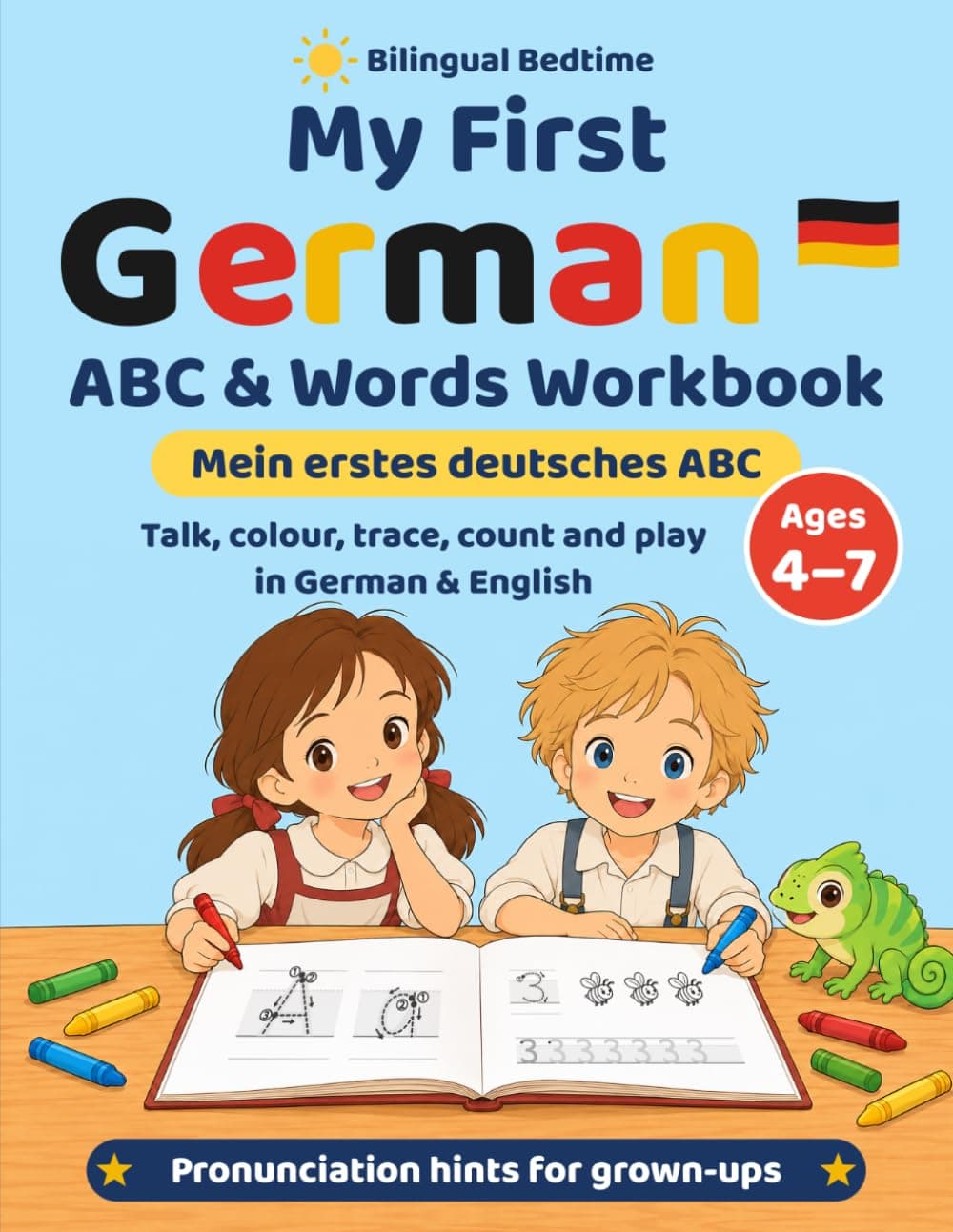
My First German ABC & Words Workbook.
Talk, colour, trace, count and play in German & English
A first German workbook for children aged 4–7 to share with a grown-up: trace every letter from A to Z, colour thirty big pictures, count to twenty and try little conversations with Lina and Ben, with English instructions and pronunciation hints so you can join in without any German.
180 pages · Paperback · Ages 4–7
the first row of the alphabet chart: A, B and C, each picture word with its article and its English
What's inside, in order.
Warm-ups, numbers, colours and shapes first, then the alphabet a letter at a time with talk pages along the way, German's special sounds, and the games, dictionary and answers at the back.
This workbook is for a child of four to seven and a grown-up doing it together, and the grown-up needs no German. Each instruction to the child is printed in German with the English beneath it. The picture words and model sentences carry a pronunciation hint in square brackets, spelt in English letters with the stressed syllable in capitals, so der Apfel is [dair AHP-fuhl]. A key on page 8 explains the system once: for the sounds English lacks, the hints always write ew for ü, er for ö and hh for the soft ch of ich. Nobody expects the child to read the German alone. You read it aloud, and the child points, says it back, traces and colours.
The alphabet runs four pages to a letter. First comes a tracing page: the capital and the small letter with start dots and numbered arrows, then the letter's own word and two more to trace, so A wie Affe comes with der Apfel and die Ananas. Next is a page to practise and play. For most letters a grown-up says the picture words and the child circles the ones that begin with the letter, then there is a maze, a dot-to-dot, a letter hunt, a matching game or a word jumble. Third is a full-page picture to colour, with a small box beside its word to colour blue for der, red for die or green for das. The fourth page, on the back of the picture, is an optional page to draw or write on. Coloured pencils and crayons work best, and the book warns that felt pens can show through.
Before the letters come ten pages of Schwungübungen, pre-writing swings with a small job each: drive the car to the house, make it rain on the flowers, take the snail round its loops. Then the numbers 1 to 10 to count and trace, 11 to 20 as an optional extra, ten colour words and five shapes. After Z, four more units take the sounds German spells its own way: Ä, Ö, Ü and ß, then Sch, then Ei, Au and Eu, then St and Sp. Eight talk pages are spread through the book, where Lina and Ben say hello and then talk about age, favourite colours, feelings, family, food and toys, and each one ends with the child asking the grown-up the same question back. At the back are a board game, sixteen pairs of memory cards to cut out, a picture dictionary, the answers, a certificate and a last page for the child's own favourite words.
- 01Das ABCThe alphabet, a picture word for every letter
- 02SchwungübungenTen pages of pre-writing swings
- 03ZahlenNumbers 1 to 10, then 11 to 20 as an extra
- 04FarbenTen colours and a colour-by-numbers picture
- 05FormenCircle, square, triangle, star and heart
- 06Buchstaben A bis ZFour pages for every letter, and five review pages
- 07SprechenEight talk pages with Lina and Ben
- 08Besondere LauteÄ, Ö, Ü and ß; Sch; Ei, Au and Eu; St and Sp
- 09Das Märchenwald-SpielA board game through the fairy-tale forest
- 10Memo-SpielSixteen pairs of memory cards to cut out
- 11Mein Bildwörterbuch107 picture words with der, die or das
- 12LösungenAnswers for grown-ups
…then a certificate, and Meine ersten deutschen Wörter, a last page where the child draws and writes their own favourite words.
Why this edition.
Hints for a grown-up with no German
The picture words and model sentences carry a hint in English letters, with the stressed syllable in capitals: Affe is AH-fuh, Zug is tsook. One page at the front explains the system, and each sound English lacks keeps a single spelling throughout, so ü is always ew and Tür is tew(r). The hints are approximate, as the book says.
der, die and das from the start
German nouns are learned with their article, and a note for grown-ups explains why. The picture words are taught with der, die or das, each colouring page has a small box to colour for its word's article, blue, red or green, and a review page asks the child to say each word with its article and circle it. The picture dictionary gives the article for all 107 words, with the English and a hint.
Little conversations, not just tracing
On each of the eight talk pages, Lina and Ben model a short exchange, the child practises it with a grown-up, then makes it their own: their name, their age, how they feel today, who is in their family. Pointing or drawing is enough, and personal answers have no score. Every page ends with the child asking the grown-up the question back: Wie alt bist du? Und du?
Pitched for four to seven
The guide for grown-ups suggests five to ten minutes to begin with, and stopping sooner if the child has had enough. Four- and five-year-olds point, say and trace with a finger; six- and seven-year-olds trace, then try the empty space and the Jetzt du! rows on their own. Profi tasks add optional challenges for older children, and the numbers 11 to 20 can be skipped or just counted along.
Games to finish with
A two-page board game winds through the fairy-tale forest to the castle: roll the die, move your counter, and say the German for each picture square you land on. Sixteen pairs of memory cards are there to cut out, starting with four pairs while a grown-up reads the word cards aloud. Mazes, dot-to-dots and letter hunts run through the letter pages, and a certificate waits at the end.
the question and the three replies on the feelings page: the English is printed under each German line, the hints at the foot of the page for the grown-up
The details.
- Series
- Bilingual Bedtime
- Language pair
- German and English, with pronunciation hints for grown-ups
- Format
- Paperback
- Print length
- 180 pages
- Trim size
- 8.5 × 11 in
- Coverage
- Letters A to Z, plus Ä, Ö, Ü, ß, Sch, Ei, Au, Eu, St and Sp; numbers 1 to 20; ten colours; five shapes; 107 picture-dictionary words
- Illustrations
- Black-and-white line art: 30 full-page pictures to colour, and a picture for every dictionary word
- Level
- Ages 4–7
- Published
- October 2026
- ASIN
- B0HNTQHNDZ
More in German.
Every edition is printed on demand by Amazon.
Start German together, one letter at a time, with the hints a grown-up needs printed on the page.
Buy paperback