opencopyInterlinear Books
Look insideHow it worksBlogContact
  • Look inside
  • How it works
  • Blog
  • Contact
Bilingual Bedtime/German songs
WiegenliedLullaby

Müde bin ich, geh zur Ruh.
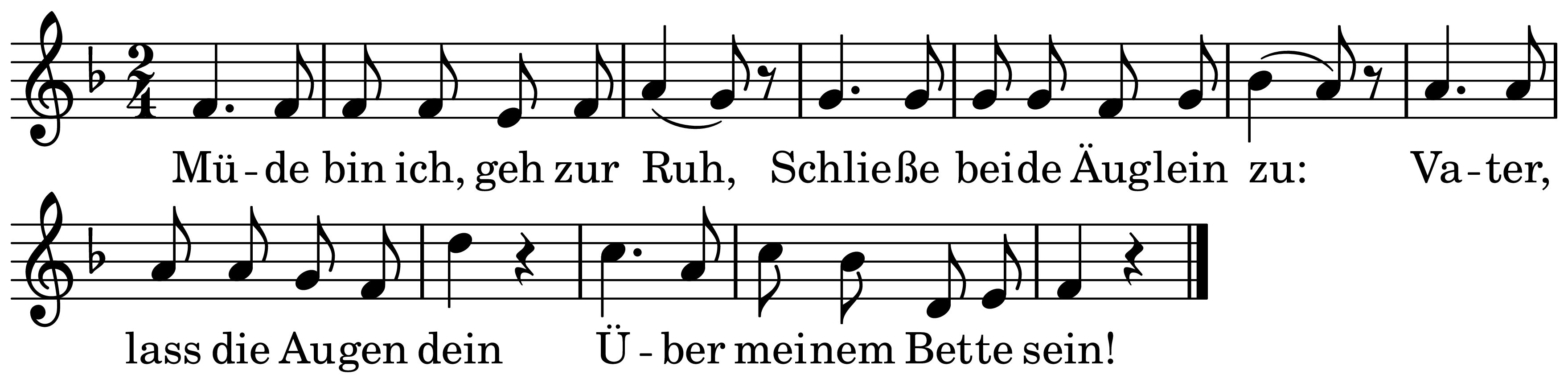
The melody of Müde bin ich, geh zur Ruh on a staff, as engraved in the book
Download the tune

The melody as written on the staff, so you can learn the tune before you sing.

Verse 1

  1. Müde bin ich, geh zur Ruh,mew-duh bin ikh, gay tsoor roo,I am tired, I go to rest,
  2. Schließe beide Äuglein zu:shlee-suh bai-duh oyk-lain tsoo:I close both little eyes:
  3. Vater, lass die Augen deinfah-ter, lahs dee ow-guhn dainFather, let those eyes of yours
  4. Über meinem Bette sein!ew-ber mai-nuhm beht-tuh zain!Be over my bed!

Verse 2

  1. Hab ich Unrecht heut getan,hahp ikh oon-rehkht hoyt guh-tahn,If I have done wrong today,
  2. Sieh es, lieber Gott, nicht an!zee ehs, lee-ber got, nikht ahn!Do not look at it, dear God!
  3. Deine Gnad und Jesu Blutdai-nuh gnaht oont yay-zoo blootYour mercy and Jesus' blood
  4. Macht ja allen Schaden gut.mahkht yah ahl-luhn shah-duhn goot.Make every hurt good again.

Verse 3

  1. Alle, die mir sind verwandt,ahl-luh, dee meer zint fer-vahnt,All those who are related to me,
  2. Gott, lass ruhn in deiner Hand.got, lahs roon in dai-ner hahnt.God, let them rest in your hand.
  3. Alle Menschen, groß und klein,ahl-luh mehn-shuhn, grohs oont klain,All people, great and small,
  4. Sollen dir befohlen sein.zol-luhn deer buh-foh-luhn zain.Shall be commended to you.

Verse 4

  1. Kranken Herzen sende Ruh,krahn-kuhn hehr-tsuhn zehn-duh roo,Send rest to sick hearts,
  2. Nasse Augen schließe zu;nahs-suh ow-guhn shlee-suh tsoo;Close tearful eyes;
  3. Lass den Mond am Himmel stehn,lahs dayn mohnt ahm him-muhl shtayn,Let the moon stand in the sky
  4. Und die stille Welt besehn!oont dee shtil-luh vehlt buh-zayn!and gaze upon the quiet world.
About this song

Luise Hensel wrote this Christian bedtime prayer in Berlin in 1816, aged eighteen, and German children have said it ever since. Verse 2 asks God to overlook the day's wrong and names Jesus' blood. The tune is the Kaiserswerth one of 1842. Äuglein means little eyes. Sing it slowly, on the edge of the bed.

Where it comes from

The words: Luise Hensel, Nachtgebet, in Melchior von Diepenbrock (Hrsg.), Geistlicher Blumenstrauß aus spanischen und deutschen Dichter-Gärten (Seidel, Sulzbach, 1829), S. 270.

The tune: The 1842 Kaiserswerth engraving, read note by note off the page image on Wikimedia Commons, 'Müde bin ich, geh zur Ruh (Kaiserswerth 1842).jpg', which reproduces pages 12 to 13 of the Lieder-Buch für Kleinkinder-Schulen und die untern Klassen der Elementar-Schulen (Kaiserswerth 1842), song Nr. 24, marked 'Bittend.'. F major, 2/4, three systems of four bars, no upbeat; F major already lies between C and G, so the key is kept and nothing is transposed. Range D4 to D5. Cross-checked note for note against the Evangelisches Gesangbuch melody MIDI on Commons ('Müde bin ich, geh zur Ruh.mid', soprano track), which de.wikipedia calls the Kaiserswerth tune 'mit wenigen Abweichungen': its 28 soprano notes agree with this staff degree for degree, including the leap up to D5 on 'dein' and the drop to D4 on 'Bet'. The single difference is the hymnal's, not ours: Kaiserswerth ends the first two lines with a slurred two-note fall, A4 to G4 on 'Ruh,' and B flat 4 to A4 on 'zu:', and the hymnal flattens each to the second note alone. The 1842 slurs are engraved here, so the staff has 30 notes under 28 lyric syllables

From the book

Bilingual Bedtime

Thirty-Seven German Songs for Children

Buy paperbackBuy KindleBuy hardcoverAbout this edition
Weißt du, wie viel Sternlein stehenAll 37 songsDer Mond ist aufgegangen
opencopy© 2026
Look insideHow it worksBlogAboutJobsContactPrivacyTermsAccessibility